3 Easy Ways to Make Your Marriage More Fun
What sounds better than a fun, fulfilling marriage? Nothing!!
If you’re married, you know keeping things interesting takes a little effort, but what things in life worth having don’t? You’ve signed up for a lifelong pursuit of your spouse and to fall in love with them over and over again. Having fun together helps naturally draw you closer and rekindle the flame.
1. Add elements of surprise!
- Text your spouse something spicy during the workday. Make it out of the blue and with no business attached, (aka, no talk about what’s for dinner or what needs to get done) just some good flirtatious banter.
- Surprise your spouse by wearing their favorite outfit or favorite outfit under your outfit (if you catch my drift) and suggest an impromptu date night.
- Send them something at work—could be something as small as a coffee or as grandiose as an edible arrangement.
- Pick something up for them while you’re out running errands just because.
2. Play together!
- Play is essential to having fun in marriage. There are not only relationship benefits to playing together but health benefits! The National Institute for Play (NIP) believes (and has the research to back it up) that play can dramatically transform our personal health and our relationships. It can be board games, video games, a puzzle, a Minute To Win It challenge, Dominos, cards, tag around the house, strip poker, or whatever your favorite way to spark some healthy competition is.
Play generates optimism, novelty makes perseverance fun and leads to mastery. Additionally, it gives your immune system a bounce, fosters empathy, and promotes a sense of belonging and community. Each of these by-products is an index of personal health, and their shortage predicts impending health problems and personal fragility.
3. Don’t shy away from passion!
- Light the candles, turn on some music, turn down the bed or change up the location, and enjoy the intimacy. Take time to be curious about your spouse, compliment them, cuddle up close, and turn off the phones. Alone time can be so beneficial and adventurous. It can reignite the passion and give you lovely serotonin, dopamine, and oxytocin boosts (aka, the happy chemicals in your brain).
BONUS: Free date nights!
- Surely you’ve heard it before, so you’ll hear it again: Date your spouse. The romance doesn’t need to go down as the anniversaries go up. Try new places, carve out quality time, cultivate intimacy, and enjoy being one on one. There are tons of date night ideas, free virtual date nights, and date night DIYs right here on our site free to you!
It’s easy to have fun in your marriage when you realize having fun means creating fun! Enjoy laughing together, kissing one another, and everything in between.
Some more blogs you may be interested in:
- How To Have More Meaningful Conversations With Your Spouse
- Couples Who Play Together
- 4 Ways to Be More Present With Your Spouse
***If you or someone you know is in an abusive relationship, contact the National Hotline for Domestic Abuse. At this link, you can access a private chat with someone who can help you 24/7. If you fear that someone is monitoring your computer or device, call the hotline 24/7 at: 1−800−799−7233. For a clear understanding of what defines an abusive relationship, click here.***
How to Stay Motivated During Marriage Challenges
There are days you wake up and have no motivation to go to work. Times when you don’t feel like seeing your in-laws and weekends and there’s no desire to get out of the bed anytime between Friday evening and Monday morning. However, when the lack of motivation creeps into marriage and you begin struggling to even want to work through marital challenges, it’s time to sound the alarm.
Incessant arguing. Constantly feeling hurt and empty. Money issues. The never-ending feeling of being lonely. It can feel like the easy answer is to stop trying.
Is it unusual to get to a place in your marriage where you want to give up?
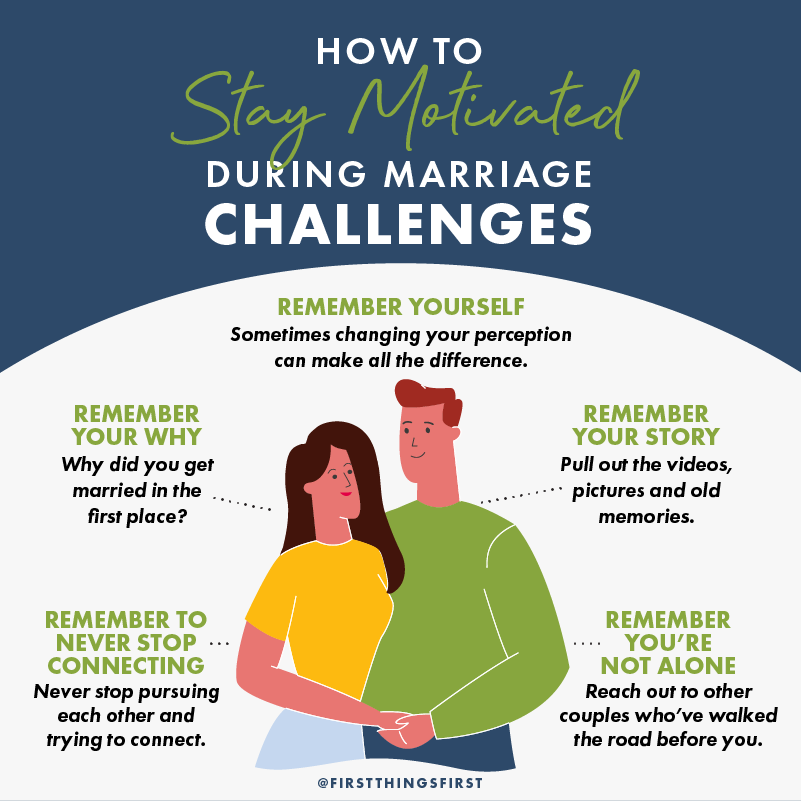
I would’ve answered this question with a loud “NO WAY” when I first got married, but then I talked to a couple who’d been married for over 40 years. I asked a simple question: “Did you ever want to give up on your marriage?”
They looked at me like I was crazy and said “Are you kidding me? Yes!” Then, they shared some dark moments in their marriage. Moments of betrayal of trust and times of extreme disconnect. They admitted there were times when they just weren’t sure. But, they also said, “We’re glad we stuck in there because we wouldn’t trade these 40 years for anything.”
How’d they do it? How did they stay motivated when they were experiencing difficult marital challenges? The couple told me their secret: “You just have to remember.”
“Remember what exactly?”
Remember your why.
Why’d you get married in the first place? People marry for several different reasons: love, kids, a passion for another, to have companionship. Your why doesn’t have to match anyone else’s why. The neverending nature of your why can help you outlast the temporary challenges you face in marriage.
Remember your story.
Pictures. Videos. Experiences. Memories mean little without the story attached to them. You look at them to remember the story. It connects you with the positive energy captured during the moment that’s worth remembering. Let that energy motivate you to keep going. Your story helps you remember what you’ve built together.
It isn’t just about reliving your past. It’s about guiding and maintaining your perception of your spouse and your marriage. It is about truly seeing the person you’re with. It’s about being reminded of who you are and even how you’ve evolved over the years.
Remember to never stop connecting.
Keep searching for better ways to communicate, be playful, and spend quality time with one another. Regardless of how challenging marriage gets, to stop communicating is never the answer. Connecting in hard conversations, through disappointments, and in the midst of hurt is better than not communicating at all. Anytime you stop talking, you’ll slowly feel the wedge between the two of you grow bigger.
Remember you’re not alone.
Hearing a couple who had been married for 40 years share some of their darkest moments was motivational for my own marriage. They were proud to have made it 40 years, and I could sense they felt their life was better for it. Since then, I’ve learned many couples, if not most couples, have gone through difficult moments where they felt like giving up was really the best option on the table. So, when you find yourself hurting and questioning if it’s worth it to hang on, reach out to other couples who have walked the road before you and made it to the other side in one piece. Connecting with other healthy couples who are willing to be honest and real can inspire you to stay focused on your marriage when it appears hopeless. Also, a good marriage counselor can help you work through some of the toughest marriage challenges.
Remember yourself.
Sometimes we get so focused on what our spouse is or isn’t doing we lose sight of ourselves. Research shows when a person has a negative perception of work, family, themselves, and just life in general, they are more likely to be unhappy in their relationships. Continue to grow and practice good self-care. It may help you to get a fresh perspective that can help you thrive in the midst of some of the most difficult times.
When you remember these things, you’ll realize no matter how big the problems may seem, your commitment to each other is bigger. The urge to stop trying is real. But, you have everything you need in your memory bank to fight the urge to quit and help your brain to keep moving forward. The darkest part of a cave is right before you see the light. Focus on using the tools you have to get to the light and stop the darkness from making you a permanent resident.
***If you or someone you know is in an abusive relationship, contact the National Hotline for Domestic Abuse. At this link, you can access a private chat with someone who can help you 24/7. If you fear someone is monitoring your computer or device, call the hotline 24/7 at 1−800−799−7233. For a clear understanding of what defines an abusive relationship, click here.***
5 Common Problems in Marriage
There are lots of things that can make your marriage great. Inevitably, your marriage will run into some bumps and cracks in the road that can cause problems. Those problems don’t have to become craters in your journey. Awareness of common marital issues can help you avoid many of them. It can also prepare you to work through them when they seep into your marriage. Here are some of the most common problems couples experience in marriage.
1. Unspoken Expectations
You know the disappointment you feel when your spouse didn’t do something you fully expected them to do. You were coming home late from work and you expected him to have dinner on the table. Instead, there’s no dinner. He expected you to spend all your recreation time with him, yet you made plans with your girlfriends on Saturday night. But the catch is, these expectations were never spoken. They were just running through your mind.
Unspoken expectations are a setup for disappointment. We often don’t realize we have them until they aren’t met. We may expect our spouse to be able to anticipate our every need or know the keys to “making us happy.” They’ve come from our experiences, history, hopes, and dreams. Sometimes they’re informed by what we see through entertainment, social media, or other “seemingly” happy couples. We have expectations about parenting, household responsibilities, money, dealing with in-laws, sex, work, etc.
They become problems when we don’t talk about them. Write them down. Have conversations about them. Communicating about them helps prevent disappointment, frustration, and hurt. It will help you have realistic expectations that will bring you closer together.
2. Poor Communication
If you hear a couple discussing a problem they’re having in their marriage, you can almost guarantee there’s some miscommunication around the issues. What he is saying is not what she is hearing. And what she is saying is not what he is hearing. People hear things differently. Examples of poor communication that have become common in some marriages include: the silent treatment, criticism, listening only to respond, expecting your spouse to read your mind, and talking over one another. Poor communication or lack of communication can lead couples to have negative perceptions of their spouse purely based on a misunderstanding.
Knowing the communication traps that are easy to fall into is half the battle. Learning to hear, communicate, and understand one another’s thoughts, emotions, and desires can turn communication into a strength in your marriage.
3. Money
It’s been said many times that if a couple can learn how to work together regarding money, then they’ll be able to work through anything. Research tells us that money is the number one thing that couples argue about. Your spending habits reflect your values. Your values are important to you, just as your spouse’s values are important to them. It’s normally not the money itself that causes the issues, though. It’s coming into agreement on what to do with the money that causes arguments and disagreements.
Secret bank accounts and wild spending habits can destroy a marriage. Openly communicating with each other about future plans, necessary purchases, and your goals can help the two of you be on the same page regarding money matters. Working together regarding how you manage your money can set you up to overcome any issue you face in your marriage.
4. Technology and Social Media
With the rise of employees working from home and the increased integration of technology in every facet of our lives, couples are in the same bed at night during the time which used to be designated for pillow talk—but they’re not talking. Instead, they’re connecting with old friends, looking at videos, shopping, playing video games, surfing the net, and generally putting their attention toward their screen instead of their partner. It’s distracting couples from loving one another and causing others to compare their relationships to what they see on social media.
Setting aside screen-free time that allows the two of you time to focus on each other will help both of you feel valued within your marriage. Be intentional about nurturing your relationship and appreciating what makes your relationship satisfying.
5. Intimacy
When couples speak different intimacy languages and aren’t able to understand one another, it’s a recipe for marital conflict. Whether it’s understanding each other’s needs for connection and vulnerability, or romance and sex, if you don’t know what arouses your partner, then you run the risk of living with a big intimacy void in the marriage.
Open conversation to discuss what makes each of you feel the most connected. Periodically doing marital checkups to make sure you’re staying connected can strengthen your marital intimacy.
None of these problems have to destroy your marriage. Working together to deal with problems in marriage will create a bond and security that gives you the confidence that your marriage can make it through anything. You don’t have to do it all by yourself. Having other healthy married couples in your lives you can talk to or seeing a good marriage counselor can help you overcome problems that are very difficult for the two of you to solve together. Problems don’t have to be something that you dread. Instead, they can be opportunities to strengthen your relationship and bring positive growth.
***If you or someone you know is in an abusive relationship, contact the National Hotline for Domestic Abuse. At this link, you can access a private chat with someone who can help you 24/7. If you fear that someone is monitoring your computer or device, call the hotline 24/7 at: 1−800−799−7233. For a clear understanding of what defines an abusive relationship, click here.***
Married. You and your spouse talk every day and you sleep in the same bed. You share bills and responsibilities. Of course, you have sex. You do all the things married couples do. Yet you so often feel unheard and unknown by your spouse.
You don’t feel like your spouse knows your hurts and pains. They’re unaware of what causes you to be fearful or insecure. When the two of you talk about personal or intimate matters, you don’t feel like your spouse gets you even though you shared exactly what you were thinking and feeling.
You’ve made comments to express your feelings that they didn’t get. Your conversations are not fulfilling. It’s made your sex life one-sided because you don’t feel known or heard so you’re not as into giving yourself to your spouse in that way. And you’re not sure if they notice or even care.
How does this happen?
One possible explanation is your spouse isn’t curious about you anymore. Curiosity pushes someone to want to know all the complexities of their spouse’s thoughts, personality, dreams, and feelings. It drives you to understand how past experiences affect your spouse in the present.
Curiosity can stop for several reasons:
- Your spouse believes they know all the important things there are to know about you.
- The busyness of life has subconsciously shifted the priorities.
- Your spouse has become more focused on themself.
- Complacency in the relationship and in their own personal growth.
As a result, spouses often don’t hear their partner’s cries to be heard. They miss the snarky comments, make assumptions about the marital silence, and overlook opportunities presented to show they hear and know you. You may be evolving or even changing, but your spouse still speaks to you based on how you thought when the two of you first got together.
What can you do about it?
Yes, you have to talk about it. The struggle of letting your partner know you’re feeling unheard and unknown is getting them to hear from you. Ironic, right? This is a conversation that my wife and I had for years before I finally heard her. Did I think I’d heard her before? Of course, I did! I’d listened to what she said and tried to treat her based on the words she said. However, she knew I didn’t hear her because I didn’t become genuinely curious about her. I was still interacting with her as if she hadn’t grown or evolved since we first met. Consequently, I was missing out on getting to really know her and her new ideas, dreams, and desires.
You’ve probably tried many times to get your spouse to really hear and know you. All to no avail.
Here are the keys to being truly heard by your spouse.
- Gentleness. Getting louder, forceful, or playing the blame game is not the way to get heard. Marriage therapist and researcher John Gottman has coined the phrase, “Gentle Start-Up.” You can attack your spouse with insults or approach your spouse with gentleness. It hurts to be married and feel unknown, but to approach your spouse with anger and rage is more likely to cause defensiveness than to birth helpful conversation.
- Be Direct. Don’t Hide Your Emotion. Your spouse does need to see your emotions in a healthy way. Nothing violent, abusive, or manipulative. Hurt, neglect, sadness, and loneliness are all real emotions that can help your partner understand the gravity of the problem.
- Perception. Approaching your spouse from the perspective that they do want to make you happy. They love you and want your marriage to work. Battling the tension between feeling like your spouse is not interested in you and knowing they love you and want you happy can be tough, but it is doable.
- Clarity. What makes you feel heard and known? When do you feel lonely within your marriage? It may take several conversations to communicate all that’s on your heart and even more for your spouse to get it. Repetition from a gentle spirit is helpful.
Don’t Give Up.
If the two of you are both well-intentioned and you both want the marriage to work, then keep pressing forward. Talking to other couples who have experienced similar struggles can be encouraging. Talking to a marriage counselor may be empowering. I’ve heard many spouses say that after so many years, “My spouse finally gets me!” When that happens, you go from the feeling of being unnoticed and unknown to experiencing levels of connectedness and intimacy that’s very difficult to find outside of a committed relationship. A marriage where you both feel heard and known is a relationship that offers the security and comfort which brings peace to the soul.
***If you or someone you know is in an abusive relationship, contact the National Hotline for Domestic Abuse. At this link, you can access a private chat with someone who can help you 24/7. If you fear that someone is monitoring your computer or device, call the hotline 24/7 at: 1−800−799−7233. For a clear understanding of what defines an abusive relationship, click here.***
How to Find Good Relationship Advice
You want to have good relationships. You want a healthy marriage AND you want to be a great parent, a wonderful friend, fiancé, or co-worker.
But relationships are sometimes complex. They aren’t always easy. Issues arise. And if you’re like me, you could just use some help sometimes.
The internet gives us ENDLESS information on relationships. Just Google how to resolve conflict in marriage or how to parent a rebellious teenager. Then watch TONS of articles, blogs, videos, how-tos, and step-by-steps fill your screen.
It’s overwhelming.
And here’s the thing: can they all possibly be right? I mean, with literally thousands of resources out there on any given relationship subject, there’s got to be some conflicting information and something that’s not accurate. (As a matter of fact, there is.)
★ So when you and I are trying to get help in the area of healthy relationships, how do we know what kind of information to trust? How do you wade through the countless sources of information on your screen and determine which advice is legit?
I’ve been on both ends of this spectrum, searching for accurate relationship advice as well as writing relationship content as accurately as possible. And I can tell you there is a lot of good information out there, as well as a lot of bad.
Here are some pointers I’ve found helpful on how to identify reliable relationship advice.
Understand that relationships are something that’s actually researched.

Seriously, there’s a whole science behind it. There are a lot of experts and researchers out there looking at questions like what makes a marriage great, what kids need from their parents, what are the best ways to resolve disagreements, what role does intimacy play in relationships, etc. And, they’re observing and testing answers using psychological research techniques.
This is good to know because it tells us that there is, indeed, reliable information out there to tap into for our relationship questions and struggles. Good sources of information are typically (but not always) written by researchers who have either done the science themselves or by professionals who have used the science to counsel others. That’s usually what I want to look for when it comes to good relationship advice.
On the flip side of the coin… know that just because the word “research” shows up doesn’t always mean it’s great advice.
I’ve read countless articles using the words research says… or studies prove… or a survey of 500 people tells us… If you search for any kind of advice about relationships, you’ll find this, too. And it sounds very convincing.
But for many reasons, it doesn’t always mean you can trust the advice. For one thing, it’s easy for writers to twist the words of a piece of research out of context to fit their own point of view. Not to mention, a lot of research just plain isn’t done well. You don’t have to be any kind of research expert to take what you read or watch with a grain of salt or even sense there could be some missing information.
I’m not saying count these kinds of articles out. Give them a chance. Just approach them with a more critical eye. And here’s something I’ve found: if you come across an article that says some sort of research proves something, approach with caution. Researchers don’t try to prove anything. The goal of the research is to provide evidence of one thing or another and spark people to study the question even more. Claiming proof for something could be a big red flag that the writer could be twisting some facts.
All this goes to say, of course, to consider the source.
With any article or video, take a quick look at the author’s bio. Google them. Do they have a background in relationship research, education, or counseling? Are they associated with a university or an organization specializing in relationships like marriage or parenting? Do they have a product to promote? Does their writing seem to have an agenda? Does it sound like they have a chip on their shoulder (like they’re ready to pick a fight)? Or, are they simply trying to report the best information out there as objectively as possible? These are all important questions to consider.
Do a quick search on “reviews” or “criticism” of the author or the organization they represent. See what other people are saying about them.
I particularly like authors who are transparent about their own relationships and balance it with trustworthy fact-giving. Rather than making bold claims saying what they are doing in their own relationships is the way to go, thank you very much, they tend to admit where they’ve messed up before and humbly say let’s look at evidence of what’s healthy.
Prepare to do a little digging.
I’m confident telling you it’d be a mistake to only consider the first few pieces of relationship advice at the top of your search list. Sometimes these are reliable resources, but not always. The first sites popping up on a search list many times are determined by popularity factors or advertising dollars. This means you could very well be getting relationship advice based on opinions instead of qualified research, and on the fads families of “the rich and the famous” are doing. (This is just my two cents: it’s difficult for me to swallow trying to relate to Hollywood trends in marriage and parenting. I’m not dissing actors or performers; it’s just a totally different world from the norm, and it rarely reflects what we know to be healthy in relationships.)
Dig down below the first few search results and see what else lies beneath. This is often where you’ll find the real gold of reliable relationship advice.
Be cautious with sources that seem to run against the grain of what we already know to be healthy in relationships.
I get a little twitchy when I see titles like The Way We’ve Been Doing Marriage for Decades Is All Wrong! I don’t ignore those sources completely (Who knows?—they might have some good info after all…), but I do tend to read or watch it with a lot more discernment and savvy. Apply what’s been said above to these kinds of articles and determine for yourself if the information given is truly on the level.
Understand how easy it is to find information that supports your current view and quickly rest your case.
These days you can just about find anything that will claim to back up even the wildest of ideas on how to do healthy relationships. (“Survey Proves a Steady Diet of Tacos Will Improve Your Marriage” — I knew it!)
So if you’re simply trying to find something to support the opinion you already have, then guess what? You’re going to find it.
When approaching a piece of relationship advice that may run counter to your viewpoint, I find it helpful to give the information a chance. I’ll often think to myself, “Could there be the possibility that this differing opinion (other than mine) might have some truth to it?” And then, based on all the things I’ve talked about above plus a dose of common sense, I determine if the advice is worth taking.
If you truly want to learn what healthy marriages, parenting, friendships, dating, and work relationships look like, good information is out there for you to get your hands on. But it’s like swimming in the middle of the ocean. There is a virtual sea of information to swim through. Much of the advice is like currents which will guide you safely to the shore of healthy relationships. But there are some riptides of bad information that can drag you further out to sea.
One more thought to leave you with: finding relationship experts online can be extremely helpful.
But let’s not look past the fact that you probably have actual people around you in healthy (but not perfect) relationships who you can lean on. A get-together over coffee where you can ask this person (or couple) questions about how they do things in their relationships can provide some very practical wisdom.
Put the above ideas into practice, lean on the healthy people you know, and I guarantee you’ll learn more about what makes relationships healthy than you ever thought you could have.
***If you or someone you know is in an abusive relationship, contact the National Hotline for Domestic Abuse. At this link, you can access a private chat with someone who can help you 24/7. If you fear that someone is monitoring your computer or device, call the hotline 24/7 at: 1−800−799−7233. For a clear understanding of what defines an abusive relationship, click here.***
This DIY date night all about strangers’ stories can be done at home OR in a coffee shop or restaurant! There are a few variations you can choose from, so feel free to pick one that works best for you and your honey. This date night is unique because it takes the focus off of you and your love and onto a stranger—while still bringing the two of you closer!
Supplies:
- A Notebook
- 2 Pens
- A Little Creativity! (And/or this list of short story ideas!)
At A Coffee Shop/Restaurant:
The goal of this date night is to come up with a short story using help from strangers! As you’re sitting with your honey, take a look around the room for help writing your story. Check out these ways you can use your environment to pull in pieces of your story!
- First of all, take a look around the room. Choose one stranger to be the main character.
- Pick another stranger to infer the location from (if they’re wearing a sports team logo, choose that city; if they have stickers on their computer from another state/country, choose that location; etc.)
- Use the coffee shop or restaurant you’re in to choose the setting/timeline (Is the furniture antique? Set it in the 1920s! Modern? Set it in the future! Find the origin of a dish/drink on the menu and when it was first introduced!)
- Pick another stranger to be the minor character.
- Decide together what the main conflict will be!
Then take some time writing your short story about strangers together.
At Home:
If you don’t feel like going out to a coffee shop or restaurant, try this variation of the date night! Grab that notebook and a couple of pens and sit on a comfy couch with your honey. Get some snacks and drinks together, too, if you want!
The goal of this date night is to write a fictional story about real-life strangers. Now, you have a couple options… If you have a neighbor that you’ve seen around but haven’t met, pick him/her! Or maybe there’s a barista in your local coffee shop that seems fascinating. Choose someone that is a part of both of your lives, but you don’t know very well.
Now, take turns coming up with “facts” about that person! What can you guess about their life based on the minimal interactions you’ve had with them? Where they’re from? What era they would choose to be from? The main conflict in their life? Then, write a short story based on those facts!
If you’re brave enough, next time you see that person, ask a few simple questions to get to know them and see how close you were!
Looking for more DIY date nights? Click here!
Image from Unsplash.com
8 Ways To Care for Your Spouse’s Mental Health
Full transparency here: I’ve dealt with feelings of depression and anxiety through much of my adulthood. In fact, I brought it right with me into my marriage. Through it all, my wife has been a solid rock of support and encouragement for me and my mental health during those difficult times. And looking back, I’ve been able to catch a glimpse of what she was feeling for me:
I’m worried for his well-being. I know he isn’t himself. His heart is hurting. His mind is swarming. He’s just on edge all… the… time. There’s no life in his voice. He just has a sense of hopelessness, tension, defeat. And I just want him to be happy again so we can enjoy our life together like we once did.
Does any of this sound familiar?
Maybe you’ve had the same thoughts about your spouse. It’s difficult to see the person you love the most experiencing challenges like grief, sadness, anxiety, and stress. It impacts not only your spouse but also your marriage. And you want to help, but maybe you just don’t know how.
Fortunately, there is hope. How can you show care and support for your spouse’s mental health? Here are eight ways:
1. Remind them you are there.
One of the worst feelings someone can have who is experiencing emotional difficulties is feeling like they are alone in their predicament. The continual reminder that you are there for them, you’re there to listen, and you are not there to judge or think less of them because of what they’re going through means the world.
2. Encourage your spouse with The Big 3: Exercise, Diet, and Sleep.
These are the three best things we can do to help ourselves when our mental health is under attack. They are the “hubs” of self-care. Physical activity, especially cardio, and clean eating have been shown to improve emotional health. And I can’t tell you enough just how important sleep is to fight off stress, anxiety, and depression. Most people need 8-9 hours of sleep each night, and each one of those hours is precious to care for yourself. Encourage your spouse to maintain The Big 3 and join them in the mission to work out, eat clean, and sleep well.
3. Do everyday activities together.
When I’ve felt particularly out of sorts, my wonderful wife would invite me to go on an errand with her or to do something seemingly mundane with her around the house. The sheer act of being together and focusing on some activity — picking up the groceries, folding the laundry (lots of bonding happens over folding fitted sheets), getting the car washed (for an added bonus, jamming out to Led Zeppelin as your car shuffles through the automatic wash, an instant feel-good) — can help pull your spouse out of a funk.
4. Coach your spouse to choose their “Something to Look Forward to.”
Long ago, a friend of mine gave me this life-changing, simple piece of advice, and my wife has encouraged me with it: every week, choose that one thing that you’re going to look forward to on the weekend (or whatever the “end of the week” looks like for your spouse). It can be anything enjoyable: a hike, watching the football game, ordering pizza, eating that piece of cake in the fridge, a fishing trip, working in the yard, smoking some ribs, visiting your favorite fast food place. I’ve found that whatever setbacks I experience through the week, sometimes my “Something to Look Forward to” is what helps me to keep taking each step forward. Help your spouse find their “Something to Look Forward to” each week.
5. Experience some fresh air together.
There’s something about being outside in the open air and the warm sunlight that takes the edge off strong emotions. Invite your spouse to share some outdoor time, whether it’s hiking in the woods or sitting on the front porch to watch the sunset. You certainly don’t have to be an “outdoor person” to gain the benefits that clean air and the vitamin D from sunlight provides (which, by the way, has been shown to reduce depression and boost weight loss).
6. Be physically intimate with each other.
Physical touch, whether it’s sexual or non-sexual touch, like holding hugs or hand-holding, has been shown to help improve mental and emotional health, not to mention increase closeness and connection with each other. Healthy physical touch from someone who cares (that is, you) causes those feel-good chemicals to squirt through the brain, defending against feelings of sadness and anxiety. And don’t laugh, but scheduled sex is where it’s at. Hear me out. If your spouse is someone who, say, really enjoys sex, more than likely it’s a stress-reliever for them. When the two of you schedule your lovemaking, you give them something they can count on to simmer down the emotions while you, well, heat things up.
7. Encourage time with friends and family.
It’s easy for someone weighed down with heavy feelings to isolate themselves. Sometimes you just don’t have the energy to reach out to others. When I’ve felt like this, my wife would sometimes say something like, “Why don’t you call up your friend Brian and see if he wants to watch the football game?” Or, “Why not go over to your mom’s house and take her some cookies” Being with others helps a heavy heart. And sometimes a person just needs a shot of encouragement to make that connection. Encourage time with someone they are close to when the mood is down.
8. Go on dates.
This is arguably the most important item on the list. Try to have a weekly date together. It doesn’t have to be elaborate or expensive or even outside the house. As a matter of fact, take some of what’s above and make it a date: the “Something to Look Forward to,” time spent outdoors, ordering a pizza in, a walk around the neighborhood, a Netflix movie, or maybe even scheduled intimacy. The point is to have a meaningful time together. And remember: because your spouse is dealing with heavy emotions, you may have to be the one to prompt these dates.
If you observe that your spouse’s mental health doesn’t change for the better or gets worse, encourage them to visit a professional counselor. Offer to go with them if they are nervous or uncertain. Try to help them understand that talking to a counselor doesn’t mean they are “broken” or something “is wrong with them.” They are simply there to talk through some of the difficult feelings they’re experiencing.
One more thing: the battle to manage strong emotions like anxiety, sadness, or stress is a marathon, not a sprint. Don’t expect instant improvements with a walk in the woods or a night out on the town.
And let’s not ignore the fact that your spouse’s struggles with mental health are hard on you as well; you feel the exhaustion and stress they feel. Be sure you are taking care of yourself. Get plenty of rest and exercise, and make sure you have a healthy support system you can turn to. Practice good self-care.
You are your spouse’s biggest support. And you have the power to instill a sense of hope in them with your love and encouragement. Choose at least one of the strategies above to do this week. Assure your spouse you are there for them no matter what. Go on a date. Share a walk outside. Whatever it is, let them know you are right there beside them. Believe me: it will mean the world to them.
***If you or someone you know is in an abusive relationship, contact the National Hotline for Domestic Abuse. At this link, you can access a private chat with someone who can help you 24/7. If you fear your computer or device is being monitored, call the hotline 24/7 at: 1−800−799−7233. For a clear understanding of what defines an abusive relationship, click here.***
Image from Unsplash.com
Ahhhh! The brisk air, the pumpkin-flavored-everything, the changing leaves… It’s finally fall! Although your typical pumpkin carving, corn maze, apple cider filled celebrations might look a little different this year, it doesn’t mean you can’t enjoy the season with your honey. Pick a few of these activity options for this fall-themed date night!
Activity Options:
DIY Halloween Costume:
- Set a timer for 25 minutes.
- Each person has until the timer goes off to make a Halloween costume for their partner!
- Use anything and everything from around the house – the more creative the better!
- BONUS POINTS if you wear this costume as you’re doing any of the other activities below!
ILY, PSL:
- Grab that “pumpkin spice” shaker from your spice cabinet and let’s get creative. Nothing screams fall and date night like some pumpkin spice!
- Try to make your favorite dish into a Pumpkin Spice masterpiece! From cinnamon rolls to pizza, anything can be turned into a fall dish with a little pumpkin spice!
Jack O’ Painting:
- Sure, everyone loves a great carved pumpkin, but not everyone is talented with a keyhole saw!
- All you need is a couple of pumpkins, some acrylic paint and a good brush, and you’re all set!
- Bonus points if you and your partner make themed pumpkins! (A bride & groom, a witch & wizard, Cookie Monster & a jar of cookies, etc.)
Leaf Hunting:
- Grab those boots & a scarf and take a walk in your nearest park!
- Add in a little competition to see who can find the most heart-shaped leaves on the ground!
Scary Movie Marathon:
- Find a scary movie you both haven’t seen before, grab some popcorn (or that pumpkin spice dish from the previous activity) and snuggle up on the couch together!
- Want to make it a little more interesting? Turn off the volume and narrate the scenes yourself! Try and guess the story line, the emotions the characters are feeling, etc.
Questions to Ask While on The Fall Date Night:
- When was the first time you knew you loved me?
- What’s one thing about me that first made you fall in love with me?
- What’s one thing about me that keeps you continuously falling in love with me?
- How can we keep the fire burning in our relationship through the winter months to come?
- What was your favorite part of summer?
- What are you most looking forward to during fall?
- Give me one way I can help you thrive in the next two weeks.
- What in your life are you most thankful for right now?
- Alternate 5 times sharing something you consider a positive characteristic of your partner.
- On a scale of 1-10, how warm and inviting would you say I am? What would you rate us as a couple? What can I do to raise that number?
Looking for more date night ideas? Click HERE!
Image from Unsplash.com
