Should You Tell Your Friends and Family about Your Marital Problems?
Have you ever walked over a frozen pond and realized just how thin the ice was? I have. You quickly understand that you need to step… very… carefully.
It’s the same when considering telling your friends and family about your marital problems. One wrong step can mean an icy plunge. It’s slippery, and it’s dangerous.
So should you or shouldn’t you? I wish I could tell you a definite “yes” or “no,” but it’s a complicated question. It depends on several things.
Before you unload your marital issues on someone, you need to ask yourself some essential questions:
1. What is your ultimate goal?
There are good reasons and not so good reasons to disclose the problems happening in your marriage to someone. Are you…
Seeking someone to tell you how you’re contributing to the problem?
Looking for advice from an older, wiser married person who’s been through it?
Looking for someone to point you toward a good marriage counselor?
These can be good reasons. Make sure you are talking to someone you can trust.
Are you…
Just needing to vent and blow off steam?
Looking for someone to agree that you are right and your spouse is wrong?
Looking for permission to keep doing what you’ve been doing in your marriage?
These usually aren’t great reasons. It can be counterproductive and hurt your spouse.
2. Who do you want to tell, and why?
Good listeners know there are three sides to a story: your side, your spouse’s side, and what’s really going on. You don’t need a cheerleader. You need someone willing to listen carefully and be willing to call you out for the part you play.
On the other side of the coin, talking to someone who is naturally going to take your side, like your mother or best friend, isn’t going to help your situation. You’re just making enemies for your spouse. Think about that.
Even worse, let’s say you just want to vent your dirty marriage laundry, and you choose, say, your mother. When the rant is over, you might feel better and move on. But guess who isn’t moving on? That’s right: Mom. This is going to make the next family gathering very awkward.
Consider talking to someone distant enough to be neutral and objective—and who will call you out when necessary and remind you of your core values and goals.
3. What are the possible outcomes that could come from telling someone?
Sure, you might feel better if you vent. But at what price? Will your friend or family member see your spouse in a positive or negative light?
If you tell someone, will the news about your marital problems spread among the family or the friend circle? Could your spouse end up feeling hurt from this? Would you say the same things about your marriage or your spouse if they were standing with you?
4. Are you having a conversation with someone that you should have with your spouse?
Often, we have conversations with other people that we haven’t even had with our spouse. If you haven’t engaged with your spouse to work toward solutions and growth, it’s unfair to do your marriage work with someone else. Do your relationship work with your spouse.
Related: How To Tell If Someone Is Trustworthy
It’s one thing to seek out encouragement and accountability. We need people in our lives who help us recalibrate and refocus. It’s definitely wise to learn from marriage veterans. Be discerning about what you share about your marriage and with whom.
Complaining to people about your spouse or running them down is always out of line.
I know you want to do what’s healthy for your marriage. You want to work through the problems. Give yourself 48 hours to gain a sense of calm and honestly answer the above questions for yourself before you make a decision to tell friends or family about your marital problems. Walk across the thin ice toward your spouse. Honor them with your words no matter who you are talking to. Rule of Thumb: If it’s not constructive, it’s probably destructive.
Related:
How to Find Good Relationship Advice
STAYING TOGETHER: Resist The Urge To Trash Husbands
☆ Have questions about this article? Post them in the comment section below!
***If you or someone you know is in an abusive relationship, contact the National Hotline for Domestic Abuse. At this link, you can access a private chat with someone who can help you 24/7. If you fear that someone is monitoring your computer or device, call the hotline 24/7 at 1−800−799−7233. For a clear understanding of what defines an abusive relationship, click here.***
What Does Trust Look Like in a Healthy Marriage?
“Trust is the glue of life. It’s the most essential ingredient in effective communication. It’s the foundational principle that holds all relationships,” according to Stephen Covey. This is especially true when it comes to trust in marriage.

Trust is essential; without it, maintaining a healthy marriage relationship is difficult.
It’s a word that is thrown around, but few take the time to actually define it. Trust is the confidence or belief that you have in someone. From that belief, you create a picture in your mind of that person. Based on their behavior, they either confirm your initial, positive view or create a negative one. Your ability to trust in marriage is established in your relationship prior to entering your marriage and should continue to grow after you say, “I do.”
Here are key trust areas in a healthy marriage:
1. Trust that we are a team, first and foremost.
In many marriage ceremonies, the statement, “Forsaking all others” is included. When you think about that vow, it means that you and your spouse became a family on the day you married and are TEAM #1. You went from ME to WE! That means making your marriage the priority. Yes, over self, over friendships and family, and over children.
2. Trust that you will be faithful.
Trusting your spouse to only share their physical self with you is a hallmark of marital faithfulness. Being faithful is not just limited to your physical relationship.
It also includes being trustworthy and honest about how and with whom:
- You’re sharing your emotions, dreams, struggles, and goals.
- You spend your time.
- You spend your money (and how much debt you have).
3. Trust that you will not purposefully try to control or harm me.
It’s important that an environment of safety and security be present in a healthy marriage. Even in the midst of normal conflict, be intentional to care for, love, and respect each other.
Choose words that inform, not inflict harm on your spouse.
4. Trust that you love me for me, not for what you can get from me.
Your spouse needs to feel loved for who they are on the inside not how they look on the outside. Being assured that your spouse would choose you again despite any physical or financial changes only forms a stronger bond between you.
5. Trust that we will turn to each other, not on each other.
In marriage, you will experience ups and downs, sadness, and hurts. As you go through the down times, leaning on each other helps lighten the load.
Knowing your spouse has your back provides a sense of security in a healthy, trusting marriage.
There is no better feeling than reaching out your hand to your spouse, and they reach back out to you.
★ Now that we have talked about ways to trust in a marriage, it’s key to examine yourselves and the experiences that shaped the way you trust individually. Your trust picture becomes shaped by the experiences you have with friends, family, and co-workers.
Unfortunately, you may have experienced betrayals and disappointments in past relationships, even with friends and family.
In order to move past hurts and create a positive trust atmosphere in your marriage, you may want to ponder these questions:
How have friends/family/past relationships broken my trust?
Have I taken betrayals from my past out on my spouse?
Has my spouse given me a reason not to trust?
Now, you can begin to move past those hurts across a bridge to a brighter and more trusting marital relationship.
Past hurts don’t have to be passed hurts. Build trust.
Check out more marriage resources here!
***If you or someone you know is in an abusive relationship, contact the National Hotline for Domestic Abuse. At this link, you can access a private chat with someone who can help you 24/7. If you fear someone is monitoring your computer or device, call the hotline 24/7 at 1−800−799−7233. For a clear understanding of what defines an abusive relationship, click here.***
Image from Pexels.com
How to Stay Motivated During Marriage Challenges
There are days you wake up and have no motivation to go to work. Times when you don’t feel like seeing your in-laws and weekends and there’s no desire to get out of the bed anytime between Friday evening and Monday morning. However, when the lack of motivation creeps into marriage and you begin struggling to even want to work through marital challenges, it’s time to sound the alarm.
Incessant arguing. Constantly feeling hurt and empty. Money issues. The never-ending feeling of being lonely. It can feel like the easy answer is to stop trying.
Is it unusual to get to a place in your marriage where you want to give up?
I would’ve answered this question with a loud “NO WAY” when I first got married, but then I talked to a couple who’d been married for over 40 years. I asked a simple question: “Did you ever want to give up on your marriage?”
They looked at me like I was crazy and said “Are you kidding me? Yes!” Then, they shared some dark moments in their marriage. Moments of betrayal of trust and times of extreme disconnect. They admitted there were times when they just weren’t sure. But, they also said, “We’re glad we stuck in there because we wouldn’t trade these 40 years for anything.”
How’d they do it? How did they stay motivated when they were experiencing difficult marital challenges? The couple told me their secret: “You just have to remember.”
“Remember what exactly?”
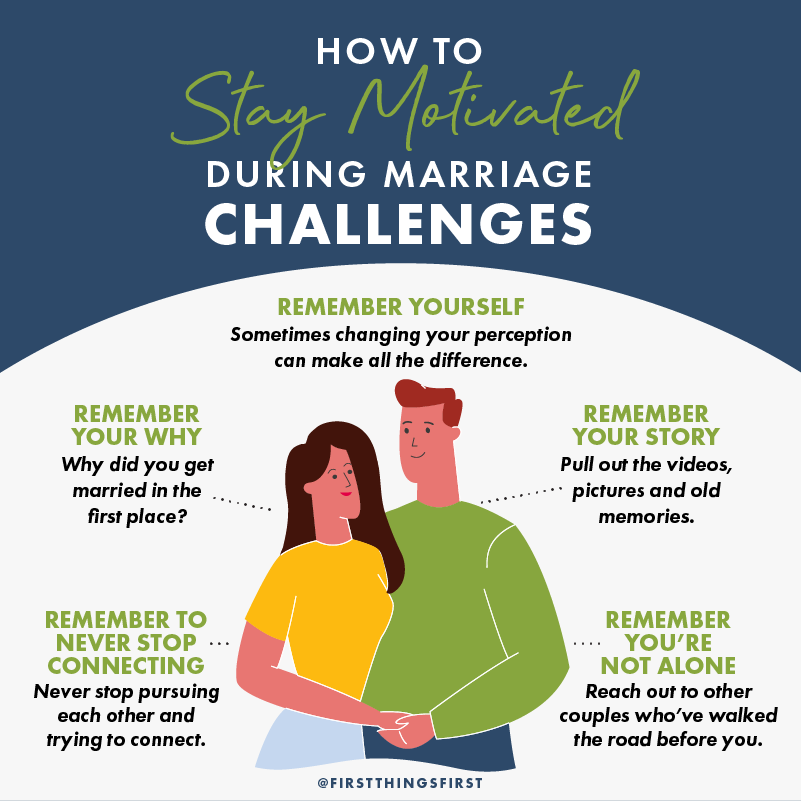
Remember your why.
Why’d you get married in the first place? People marry for several different reasons: love, kids, a passion for another, to have companionship. Your why doesn’t have to match anyone else’s why. The neverending nature of your why can help you outlast the temporary challenges you face in marriage.
Remember your story.
Pictures. Videos. Experiences. Memories mean little without the story attached to them. You look at them to remember the story. It connects you with the positive energy captured during the moment that’s worth remembering. Let that energy motivate you to keep going. Your story helps you remember what you’ve built together.
It isn’t just about reliving your past. It’s about guiding and maintaining your perception of your spouse and your marriage. It is about truly seeing the person you’re with. It’s about being reminded of who you are and even how you’ve evolved over the years.
Remember to never stop connecting.
Keep searching for better ways to communicate, be playful, and spend quality time with one another. Regardless of how challenging marriage gets, to stop communicating is never the answer. Connecting in hard conversations, through disappointments, and in the midst of hurt is better than not communicating at all. Anytime you stop talking, you’ll slowly feel the wedge between the two of you grow bigger.
Remember you’re not alone.
Hearing a couple who had been married for 40 years share some of their darkest moments was motivational for my own marriage. They were proud to have made it 40 years, and I could sense they felt their life was better for it. Since then, I’ve learned many couples, if not most couples, have gone through difficult moments where they felt like giving up was really the best option on the table. So, when you find yourself hurting and questioning if it’s worth it to hang on, reach out to other couples who have walked the road before you and made it to the other side in one piece. Connecting with other healthy couples who are willing to be honest and real can inspire you to stay focused on your marriage when it appears hopeless. Also, a good marriage counselor can help you work through some of the toughest marriage challenges.
Remember yourself.
Sometimes we get so focused on what our spouse is or isn’t doing we lose sight of ourselves. Research shows when a person has a negative perception of work, family, themselves, and just life in general, they are more likely to be unhappy in their relationships. Continue to grow and practice good self-care. It may help you to get a fresh perspective that can help you thrive in the midst of some of the most difficult times.
When you remember these things, you’ll realize no matter how big the problems may seem, your commitment to each other is bigger. The urge to stop trying is real. But, you have everything you need in your memory bank to fight the urge to quit and help your brain to keep moving forward. The darkest part of a cave is right before you see the light. Focus on using the tools you have to get to the light and stop the darkness from making you a permanent resident.
***If you or someone you know is in an abusive relationship, contact the National Hotline for Domestic Abuse. At this link, you can access a private chat with someone who can help you 24/7. If you fear someone is monitoring your computer or device, call the hotline 24/7 at 1−800−799−7233. For a clear understanding of what defines an abusive relationship, click here.***
How to Find Good Relationship Advice
You want to have good relationships. You want a healthy marriage AND you want to be a great parent, a wonderful friend, fiancé, or co-worker.
But relationships are sometimes complex. They aren’t always easy. Issues arise. And if you’re like me, you could just use some help sometimes.
The internet gives us ENDLESS information on relationships. Just Google how to resolve conflict in marriage or how to parent a rebellious teenager. Then watch TONS of articles, blogs, videos, how-tos, and step-by-steps fill your screen.
It’s overwhelming.
And here’s the thing: can they all possibly be right? I mean, with literally thousands of resources out there on any given relationship subject, there’s got to be some conflicting information and something that’s not accurate. (As a matter of fact, there is.)
★ So when you and I are trying to get help in the area of healthy relationships, how do we know what kind of information to trust? How do you wade through the countless sources of information on your screen and determine which advice is legit?
I’ve been on both ends of this spectrum, searching for accurate relationship advice as well as writing relationship content as accurately as possible. And I can tell you there is a lot of good information out there, as well as a lot of bad.
Here are some pointers I’ve found helpful on how to identify reliable relationship advice.
Understand that relationships are something that’s actually researched.

Seriously, there’s a whole science behind it. There are a lot of experts and researchers out there looking at questions like what makes a marriage great, what kids need from their parents, what are the best ways to resolve disagreements, what role does intimacy play in relationships, etc. And, they’re observing and testing answers using psychological research techniques.
This is good to know because it tells us that there is, indeed, reliable information out there to tap into for our relationship questions and struggles. Good sources of information are typically (but not always) written by researchers who have either done the science themselves or by professionals who have used the science to counsel others. That’s usually what I want to look for when it comes to good relationship advice.
On the flip side of the coin… know that just because the word “research” shows up doesn’t always mean it’s great advice.
I’ve read countless articles using the words research says… or studies prove… or a survey of 500 people tells us… If you search for any kind of advice about relationships, you’ll find this, too. And it sounds very convincing.
But for many reasons, it doesn’t always mean you can trust the advice. For one thing, it’s easy for writers to twist the words of a piece of research out of context to fit their own point of view. Not to mention, a lot of research just plain isn’t done well. You don’t have to be any kind of research expert to take what you read or watch with a grain of salt or even sense there could be some missing information.
I’m not saying count these kinds of articles out. Give them a chance. Just approach them with a more critical eye. And here’s something I’ve found: if you come across an article that says some sort of research proves something, approach with caution. Researchers don’t try to prove anything. The goal of the research is to provide evidence of one thing or another and spark people to study the question even more. Claiming proof for something could be a big red flag that the writer could be twisting some facts.
All this goes to say, of course, to consider the source.
With any article or video, take a quick look at the author’s bio. Google them. Do they have a background in relationship research, education, or counseling? Are they associated with a university or an organization specializing in relationships like marriage or parenting? Do they have a product to promote? Does their writing seem to have an agenda? Does it sound like they have a chip on their shoulder (like they’re ready to pick a fight)? Or, are they simply trying to report the best information out there as objectively as possible? These are all important questions to consider.
Do a quick search on “reviews” or “criticism” of the author or the organization they represent. See what other people are saying about them.
I particularly like authors who are transparent about their own relationships and balance it with trustworthy fact-giving. Rather than making bold claims saying what they are doing in their own relationships is the way to go, thank you very much, they tend to admit where they’ve messed up before and humbly say let’s look at evidence of what’s healthy.
Prepare to do a little digging.
I’m confident telling you it’d be a mistake to only consider the first few pieces of relationship advice at the top of your search list. Sometimes these are reliable resources, but not always. The first sites popping up on a search list many times are determined by popularity factors or advertising dollars. This means you could very well be getting relationship advice based on opinions instead of qualified research, and on the fads families of “the rich and the famous” are doing. (This is just my two cents: it’s difficult for me to swallow trying to relate to Hollywood trends in marriage and parenting. I’m not dissing actors or performers; it’s just a totally different world from the norm, and it rarely reflects what we know to be healthy in relationships.)
Dig down below the first few search results and see what else lies beneath. This is often where you’ll find the real gold of reliable relationship advice.
Be cautious with sources that seem to run against the grain of what we already know to be healthy in relationships.
I get a little twitchy when I see titles like The Way We’ve Been Doing Marriage for Decades Is All Wrong! I don’t ignore those sources completely (Who knows?—they might have some good info after all…), but I do tend to read or watch it with a lot more discernment and savvy. Apply what’s been said above to these kinds of articles and determine for yourself if the information given is truly on the level.
Understand how easy it is to find information that supports your current view and quickly rest your case.
These days you can just about find anything that will claim to back up even the wildest of ideas on how to do healthy relationships. (“Survey Proves a Steady Diet of Tacos Will Improve Your Marriage” — I knew it!)
So if you’re simply trying to find something to support the opinion you already have, then guess what? You’re going to find it.
When approaching a piece of relationship advice that may run counter to your viewpoint, I find it helpful to give the information a chance. I’ll often think to myself, “Could there be the possibility that this differing opinion (other than mine) might have some truth to it?” And then, based on all the things I’ve talked about above plus a dose of common sense, I determine if the advice is worth taking.
If you truly want to learn what healthy marriages, parenting, friendships, dating, and work relationships look like, good information is out there for you to get your hands on. But it’s like swimming in the middle of the ocean. There is a virtual sea of information to swim through. Much of the advice is like currents which will guide you safely to the shore of healthy relationships. But there are some riptides of bad information that can drag you further out to sea.
One more thought to leave you with: finding relationship experts online can be extremely helpful.
But let’s not look past the fact that you probably have actual people around you in healthy (but not perfect) relationships who you can lean on. A get-together over coffee where you can ask this person (or couple) questions about how they do things in their relationships can provide some very practical wisdom.
Put the above ideas into practice, lean on the healthy people you know, and I guarantee you’ll learn more about what makes relationships healthy than you ever thought you could have.
***If you or someone you know is in an abusive relationship, contact the National Hotline for Domestic Abuse. At this link, you can access a private chat with someone who can help you 24/7. If you fear that someone is monitoring your computer or device, call the hotline 24/7 at: 1−800−799−7233. For a clear understanding of what defines an abusive relationship, click here.***
How to Move Past an Emotional Affair
Your marriage has been blindsided by an emotional affair. One of you is struggling with thoughts and feelings of betrayal, shock, and hurt. One of you is struggling with thoughts and feelings of confusion, guilt, and sadness. How can your marriage move past this? The good news is, your marriage can not only move past this emotional affair; it can grow stronger because of this difficult circumstance—but both spouses need to be willing to to navigate the aftermath well, both individually and together.
The Spouse Who Had The Emotional Affair
Maybe you weren’t even sure you were having an emotional affair. You might have slid down the slippery slope of innocent friendship to emotional dependency and intimacy with someone who’s not your spouse. Maybe there were issues in your marriage that made it easier for you to begin to disconnect from your spouse and build a relationship with someone else. Maybe this is all about you and the little spark you got from the novelty of someone new and the secrecy of your interaction with them.
Bottom Line: You were doing marital work with someone who wasn’t your marriage partner. You crossed the boundary of faithfulness, exclusivity, deception, and betrayal.
Please read this account of how this individual was able to move past an emotional affair and how their marriage survived and grew stronger. ★ Note the steps that were taken.
[Information in brackets is mine.]
- I admitted it: Shame can only exist in secret. When I was able to voice what was really going on, all the complexities of why I allowed it to go as far as it did and how I had realized the line had been crossed, the shame that surrounded the entire situation dissipated. [This is the first step. Friendships that are innocent don’t have to be kept a secret from your spouse and are nothing to be ashamed of. Come all the way clean with your spouse.]
- I stopped it: I wrote my ex co-worker a lengthy email telling him our friendship had crossed a line and that I felt it was unfair to ourselves and our spouses to continue it. I let him know that I had told my husband and encouraged him to tell his wife and take time refocusing on his marriage too. [Inform this person that your relationship is over. Full stop. Your spouse might want to read your email or listen via conference call. This is one of the first steps in rebuilding trust with your spouse.]
- I set personal boundaries: Hindsight is 20/20, so I was able to look at my mistakes and create a guide for boundaries in future opposite-sex friendships. Such as, I will never write another man something that I wouldn’t want my husband to read. [Your spouse will likely have input for the boundaries to protect your marriage. Be willing to do whatever it takes.]
- I reinvested in my marriage: Obviously no marriage is perfect. There is always work that needs to be done. With my energy and attention refocused on my husband, we grew stronger, together. [This is the key. Your marriage is in the ICU. The “what came first” question doesn’t matter. It’s time to reconnect with your spouse and pour your energy and attention into your marriage.]
I would only add to that excellent advice that you need to apologize to your spouse, ask for their forgiveness and express your commitment to them and your marriage.
If you want to move past the emotional affair, communicate your willingness to do whatever it takes to rebuild trust and your relationship. ☆ You may need professional help to break out of the fantasy world you created and to deal with the addiction-like dynamics of your experience. You may also need professional help to reconnect with your spouse and to pour yourself into your marriage.
Emotional affairs can be just as shocking and damaging to a spouse as a sexual affair. Your spouse might bounce back and forth between hurt, anger, and normalcy. Be open to their needs, whether it is to answer questions or be alone. Understand it will take more than words and it will take time.
You need to be open to and compliant with any accountability related to your phone or other devices as you begin to rebuild trust. You need to accept any other accountability that your spouse deems necessary, including whatever else they need to feel secure, heal, and continue to rebuild trust (even if you think they’re going overboard or being unreasonable). They are probably navigating severe anxiety and hypervigilance. This is not the time to try to negotiate; it’s the time to live out true self-sacrificial love.
This is when you need good friends who are for your marriage and accountability.
The Spouse Who Was Betrayed By The Emotional Affair
You didn’t make your spouse have an emotional affair. Know this, believe this, feel this, but it is also true that affairs do not happen in a vacuum. There is always a context to infidelity and betrayal. The marriage and the affair are usually connected.
Often, the marital context allows for a better understanding of the emotional affair. As marriage therapist Esther Perel points out, “The victim of the affair is not always the victim of the marriage.” As the therapist puts it, “The betrayed spouse, to one degree or another, can be one dimension of the infidelity—just like narcissism, low self-esteem, addiction, or a mid-life crisis can be a key for understanding your spouse’s [emotional] infidelity.”
But make no mistake, your spouse chose to have an emotional affair. Probably in a series of little choices. It all could have been avoided by choosing to ignore a text, to not eat lunch with a coworker, to unfollow someone on social media, to not divulge things to someone that only a spouse should hear. They could have chosen to work on your marriage.
At a minimum, you should know the following:
- Who the emotional affair partner was.
- How long the affair lasted.
- How often they met.
- Where they met.
- How they communicated. (Email, secret texting apps, phone or burner phone, etc.)
If the marriage survives, this information is essential to avoid future affairs and for appropriate accountability and to put boundaries in place. Take time to think about what would be most helpful for you to know. Sometimes when affairs are uncovered, the betrayed spouse says they want to know every single detail of the relationship, only later to discover that all that information wasn’t really helpful.
Understand that men and women generally view emotional affairs differently. In fact, according to a survey by VictoriaMilan.com, an online affair dating site (the U.K.’s AshleyMadison.com) for people who are already married or in relationships, there are some clear distinctions between how men and women view emotional affairs.
Here’s what they discovered:
- 72% of men said sexual affairs were worse than emotional affairs.
- 69% of women said emotional affairs were worse than sexual affairs.
- 76% of women said they would forgive their partner for a strictly sexual affair
- Only 35% of men said they would forgive their partner for a strictly sexual affair.
- 80% of men said they would forgive an emotional affair.
- Only 30% of women indicated they would forgive an emotional affair.
According to this and other research, women are much more unforgiving of emotional connections while men are much more unforgiving of physical ones. Again, understand that, in general, men and women look at emotional affairs very differently.
This is important to acknowledge as you work toward understanding what happened, heal, rebuild trust, grow in security, and strengthen your marriage. Take care of yourself so that you are physically and emotionally healthy and whole.
When you’re ready, you need to offer and communicate true forgiveness. Be open and willing to change as an individual and in how you relate to your spouse. You can’t “dance the same dance” anymore. This is your new, second marriage even though it is with the same spouse. Be intentional about making it strong and healthy!
Expect good and bad days, ups and downs, three steps forward and two steps back. Healing as an individual, healing for your spouse, and healing as a couple is a process. Don’t be discouraged by bad days or setbacks. Have a friend who is for your marriage who can keep you accountable, and you can be honest with and vent to.
Don’t blame and focus on their affair partner. This is understandable but completely counter-productive, can re-traumatize you, fuel intrusive thoughts, and impede healing.
Find resources that work for you. Don’t hesitate to seek out professional counseling for yourself and marriage counseling for you both.
★ Only about 15% of marriages break up directly because of infidelity and end in divorce. According to counselors, couple’s therapists, and marriage coaches, whether the marriage will survive is based on how each spouse responds to the emotional affair.
Some Other Helpful Resources:
- How To Rebuild Trust In Marriage
- Will My Spouse Ever Forgive Me
- How To Save A Marriage That Is Falling Apart
- I Can’t Forgive My Spouse
- Infidelity And Forgiveness
- How Fear Impacts Your Marriage
- Does Your Marriage have Backbone
- How To Find A Good Marriage Counselor
- 5 Ways To Protect Your Marriage
***If you or someone you know is in an abusive relationship, contact the National Hotline for Domestic Abuse. At this link, you can access a private chat with someone who can help you 24/7. If you fear that someone is monitoring your computer or device, call the hotline 24/7 at 1−800−799−7233. For a clear understanding of what defines an abusive relationship, click here.***
Warning Signs of an Emotional Affair
Have you ever had a fight with your spouse as you were walking out the door to work and actually thought to yourself, “I can’t wait to get to work to talk with so-and-so because he/she is such a good listener and gets me.”
This thought may feel completely harmless to you at first, but once you know the warning signs of an emotional affair, it’s much easier to pinpoint what could snowball into a much bigger problem.
Do you send and receive texts with a friend or co-worker that you wouldn’t want your spouse to see?
At work, do you intentionally time your visit to the breakroom or to make copies to hopefully run into a certain person?
Are you having more conflict and less interest in your spouse as your relationship is deepening with this co-worker or friend?

These are all warning signs of an emotional affair in bloom.
It’s ironic that we can know very reliably that the two most popular times for cheaters to contact their cheating partners are Mondays between 8 AM–9 AM and Fridays between 9 PM–10 PM. It makes sense if you think about it. But take sex out of the infidelity, and it can seem very difficult to pin down when a harmless, platonic friendship or working relationship has become something that threatens the very core of your marriage.
So, what exactly is an emotional affair?
It’s when a spouse is getting an emotional need met by someone other than their partner. Perhaps they begin to make you happier than your partner and you begin to seek affirmation from this individual, or you become emotionally dependent on them, or you take your problems to them instead of your spouse. This is not just friendship. It’s an emotional attachment that should be reserved only for your spouse. It opens doors that should remain closed. You are doing your marital work with someone other than your spouse. (You’re basically “dating” someone emotionally.)
Emotional affairs also create an emotional distance from your spouse. In other words, not only are you getting emotionally entangled and closer with someone other than your spouse, but you’re creating emotional distance between you and your partner and getting further away from them. As you connect more and more with this person, you are disconnecting more and more from your spouse.
One of the biggest warning signs of an emotional affair is secrecy.
Does your spouse or partner know about this person and the friendship you share? Do you hide meetups, texts, and phone calls from your spouse? If your spouse knew how much time and energy you devoted to thinking about this person, communicating with this person, and the “tingles” you feel when you are with this person—would they feel betrayed? Would your spouse think you have stepped outside the boundaries of your marriage and your faithfulness to them?
Remember when your spouse gave you the “tingles?” Now they are locked in a battle they don’t know about which could be difficult to win. An emotional affair partner will always have the benefit of being in an idealized state and partner in a fantasized “relationship,” but your spouse will always be a real person in your real world—warts and all.
In marriage, innocent friendships aren’t hidden from your spouse, they are shared with your spouse.
“But we haven’t had sex or any kind of physical relationship! This can’t be cheating or an ‘affair!’”
In emotional affairs, instead of an actual physical relationship, there is flirting, sexual fantasizing, sexual tension, or sexual talk. (It is possible that all that is keeping this emotional relationship from becoming sexual is a set of circumstances, geography, one person’s conscience. Or it’s just a matter of time.)
People can easily and quickly go from:
Acquaintances —-> Friends —> Emotionally Codependent —> Physically Involved.
Emotional affairs are the most common form of infidelity and often are the gateway to a full-blown sexual affair. “A new crisis of infidelity is emerging in which people who never intended to be unfaithful are unwittingly crossing the line from platonic friendships into romantic relationships” – The American Association for Marriage and Family Therapy (AAMFT).
Emotional affairs are becoming increasingly more common because they can start out very innocently and are easily written off as friendships. Many couples are on guard against sexual infidelity, so emotional infidelity catches them off guard. The AAMFT found that about 45% of men and 35% of women have admitted to having an emotional affair.
Here are 20 very telling signs that your friendship is turning into an emotional affair:
- You put more effort into your appearance for him/her than for your spouse.
- You lie to your spouse about talking to and/or seeing him/her.
- You’re spending more time with him/her than you do with your spouse.
- You’re texting with him/her while trying to keep it a secret from your spouse.
- You laugh more with him/her than with your spouse.
- You think about him/her more than you think about your spouse.
- You compare your spouse to him/her in unfavorable ways.
- You feel more understood by him/her rather than your own spouse.
- You tell him/her things about yourself that you have not shared with your spouse.
- Your emotions for him/her are growing more powerful and intense.
- You keep your meetings and conversations secret from your partner.
- You say and do things with him/her you never would do in front of your spouse.
- You make a point to arrange private talk time with him/her.
- You are withdrawing from your spouse as you draw closer to your “friend.”
- You are preoccupied and daydream about him/her more and more.
- You have no interest in being intimate with your spouse, either emotionally or sexually. Instead, those feelings are toward another person.
- You and your spouse spend less time together.
- When confronted about the apparent emotional affair, you respond with, “We’re just friends.”
- You think “crush-like” thoughts like, “He/she would love this song/shirt/book!”
- You are keeping your friendship a secret from your spouse, or you no longer feel comfortable telling your spouse about this person and begin to cover up your relationship.
We often try to live in a black and white world and emotional affairs don’t fit as neatly into black and white, either/or thinking.
They exist in the grey world of our feelings, intentions, and motives. You have to be honest with yourself, but don’t underestimate your ability to rationalize, justify, and plain fool yourself about what’s really going on. If your relationship with someone is an innocent friendship, lay it out—completely—with your spouse and see if they are comfortable with it. Your spouse may be in a better position to evaluate this friendship than you are. Ultimately, your spouse’s feelings on the issues of faithfulness, exclusion, deception, and betrayal are the feelings that count.
Check out the resources, quizzes, and help for rebuilding your marriage after an emotional affair HERE.
***If you or someone you know is in an abusive relationship, contact the National Hotline for Domestic Abuse. At this link, you can access a private chat with someone who can help you 24/7. If you fear your computer or device is being monitored, call the hotline 24/7 at: 1−800−799−7233. For a clear understanding of what defines an abusive relationship, click here.***
Do you have realistic expectations for your marriage? Fast forward to being married. You text your spouse about how long your day is and how you’ll be home late. They respond saying they actually got to go home early and can’t wait until you get home.
You think to yourself, “Ah, so glad they’re getting home early, now they can get started on dinner and some of the dishes that have piled up.”
You walk in the door and let out a big sigh with the clank of your keys on the key tray and just as you’re about to say “I love you. How was your day?” you see the dishes still in the sink and the second thing your spouse says after “Hey!” is “What’s for dinner?”
I imagine you’re frustrated at this point. Your day was long and coming home to more things to do and no time to relax was not how you pictured the night going. However, did your spouse know your expectation was for them to do those things? Normally you take care of the dishes and dinner!
No one can meet an expectation they don’t know is there.
Unrealistic expectations are also unspoken expectations. If you and your spouse hadn’t talked about what you expect each other to do when one spouse gets home late, then it’s unrealistic to believe they would know what you want.
When you have unspoken expectations or aren’t willing to meet halfway, there’s no chance for either you or your soon-to-be spouse to win. What seems to be a very realistic expectation to you is very unrealistic to them because there’s been a lack of communication. You run the risk of resentment and disappointment when you judge your spouse on expectations they can’t meet or didn’t know existed in the first place.
Common Unrealistic Expectations:
Your partner is responsible for your happiness.
Your husband/wife will definitely play a role in your happiness, but they can’t be the only source. Think about things that make you happy and things that make your spouse happy. Are they all the same? Probably not. They can be your everything without being everything for you. You, like them, are human. You’ll make mistakes, you’ll fall short, and ultimately, that’s okay if you handle it in a healthy way.
Your spouse will anticipate what you want and all of your needs since you’re married now.
As amazing as that would be, being married doesn’t make you or them a mind reader. Sorry if this is a bummer for you! I’m definitely guilty of this. I often think… “Well, since my husband knows me more intimately than anyone else and since we’ve been together so long, he’ll do things without me asking. He’s just that aware. That loving. That good.” As time and experts will tell, the only way my husband can truly know what I need is by me talking to him about it. It doesn’t make his actions any less genuine because he didn’t come to the conclusion on his own (another unrealistic expectation I held when we were dating). Instead it gives him the opportunity to love and care for me in the way I specifically want and need.
The way you approach an expectation is the only right way.
If we’re honest, being right feels good, and there’s a comfort in doing things your way instead of someone else’s. However, there’s a time to set aside the “right way” if it means you get to a resolution. Choose your battles. If you expect your spouse to do the dishes, then putting the bowls on the bottom rack instead of the top rack like you do needs to be okay. Is the job still getting done? In short, yes!
You will handle conflict the same way.
You two have to come to an agreement together on how you will handle/manage conflict. If one of you needs space and the other needs to talk it out immediately, find a compromise that benefits both of you, like a timeout, and choose a time to talk about it a little bit later. Or, if your spouse feels like something needs to be said in the moment, be willing to listen first and then take a timeout. It’s important to voice your expectations so the health of your marriage doesn’t suffer on the account of unspoken words!
A Few Realistic Expectations:
- Communicate well and often; talk about how you’re feeling on a regular basis.
- Speak to each other with kindness, no matter what.
- Show respect to each other in every situation.
- Pursue each other daily.
- Say “I love you” every chance you get.
- Give your best effort at all times, and know this looks different depending on the week!
On your wedding day, you’ll vow to go above and beyond for each other, love one another wholeheartedly (flaws and all), and support each during all of the “for better or for worse” times. Remember, you’re starting your marriage with vows to meet halfway and sacrifice your preferences. Don’t let unrealistic expectations keep your marriage from being the wonderful relationship it has the potential to be.
Here are some blogs I think you might find helpful as well:
- Conversations Every Engaged Couple Should Have Before They Say, “I Do”
- 8 Must-Have Conversations for Couples
- How to Prepare Yourself for Marriage
- How to Deal With Unspoken Expectations
- EXPECTATION FRUSTRATION PART 1: Unspoken Expectations
***If you or someone you know is in an abusive relationship, contact the National Hotline for Domestic Abuse. At this link, you can access a private chat with someone who can help you 24/7. If you fear that someone is monitoring your computer or device, call the hotline 24/7 at 1−800−799−7233. For a clear understanding of what defines an abusive relationship, click here.***
Feeling Lonely in Your Marriage? Here’s What to Do.
You thought the words “marriage” and “loneliness” were oxymorons. Now you realize that isn’t the case. A Cigna study reports that in over 40% of marriages, one of the partners experiences loneliness and is unable to connect and be vulnerable with their spouse. What do you do if you’re feeling lonely in your marriage?
1. Communicate exactly what you’re feeling to your spouse.
Do not assume your spouse knows how you’re feeling. Keeping a journal where you are able to write down your thoughts and feelings is a good way to ensure that you communicate exactly what’s on your mind. Your partner may or not feel the same way. Don’t set yourself up for disappointment by expecting them to know or because they haven’t sensed the disconnect. That’s not helpful. Ask for their undivided attention, plan a special date or getaway, and be sure to share your heart. Work together to understand each other’s needs and how the two of you can reconnect emotionally.
2. Do a self-check.
It’s possible you’re expecting more from your spouse than they should be expected to give. Your spouse may be making attempts to connect with you and yet you’re unable to shake the loneliness. More and more couples are expecting their spouse to be their best friend, lover, therapist, social partner, and mentor. Studies have shown that couples tend to be less lonely when they have other positive social connections. Think through times where you felt more connected and less isolated. If you entered your marriage battling loneliness, then you may have hoped that the marriage would be the cure. Journaling, connecting with friends, getting sufficient sleep, and practicing mindfulness and self-care may be the antidote to your feelings of loneliness and isolation.
3. Create intentional times to connect.
Coffee and toast each morning. Make sure the kids have a bedtime or at least a lights out and stay in their room time. Monthly date night using a trusted family friend to babysit. Use these times to create a ritual of emotionally connecting, even if it’s just for a few minutes. You can even plan specific questions to ask or topics to discuss.
You may be feeling lonely in marriage because you feel unable to share all of yourself with your partner or because your partner doesn’t share with you. Make a point during your intentional times of connection to ask questions like: “What is bringing you the most joy and the most sadness in your life? What dreams do you have that are the most important to you? Is there anything that concerns or worries you? What do you need the most from me? What makes you feel emotionally safe?” Listen intently to each other giving cues that you’re understanding. (Check out this article on active listening skills—especially the Six Levels of Listening.)
4. Create shared experiences.
Doing fun and engaging activities together releases tensions and can create an environment of safety in your relationship. Dance, karaoke, hike, cook, go on an adventure, etc. Sharing experiences will create memories, spark conversations, and cultivate curiosity about one another. And it releases dopamine which is the “feel good” chemical in your brain.
Be intentional about getting to know each other during these experiences. Understand why your partner enjoys certain activities, what causes them fear or discomfort, and what about doing this with you makes it enjoyable.
5. Seek help.
There may be issues the two of you are finding difficult to discuss, let alone resolve. These issues may be fueling your loneliness. Talk to trusted married friends. Find a good marriage counselor to help you unpack the root of your loneliness and help you get on the path to reconnection.
Loneliness is not an unusual feeling to experience in marriage from time to time. However, it is something that couples can identify and often work together to overcome and grow stronger. Working together to emotionally connect and share yourself with your spouse will help you both reap benefits for your marriage for years to come.
***If you or someone you know is in an abusive relationship, contact the National Hotline for Domestic Abuse. At this link, you can access a private chat with someone who can help you 24/7. If you fear your computer or device is being monitored, call the hotline 24/7 at 1−800−799−7233. For a clear understanding of what defines an abusive relationship, click here.***
