What Does Trust Look Like in a Healthy Marriage?
“Trust is the glue of life. It’s the most essential ingredient in effective communication. It’s the foundational principle that holds all relationships,” according to Stephen Covey. This is especially true when it comes to trust in marriage.

Trust is essential; without it, maintaining a healthy marriage relationship is difficult.
It’s a word that is thrown around, but few take the time to actually define it. Trust is the confidence or belief that you have in someone. From that belief, you create a picture in your mind of that person. Based on their behavior, they either confirm your initial, positive view or create a negative one. Your ability to trust in marriage is established in your relationship prior to entering your marriage and should continue to grow after you say, “I do.”
Here are key trust areas in a healthy marriage:
1. Trust that we are a team, first and foremost.
In many marriage ceremonies, the statement, “Forsaking all others” is included. When you think about that vow, it means that you and your spouse became a family on the day you married and are TEAM #1. You went from ME to WE! That means making your marriage the priority. Yes, over self, over friendships and family, and over children.
2. Trust that you will be faithful.
Trusting your spouse to only share their physical self with you is a hallmark of marital faithfulness. Being faithful is not just limited to your physical relationship.
It also includes being trustworthy and honest about how and with whom:
- You’re sharing your emotions, dreams, struggles, and goals.
- You spend your time.
- You spend your money (and how much debt you have).
3. Trust that you will not purposefully try to control or harm me.
It’s important that an environment of safety and security be present in a healthy marriage. Even in the midst of normal conflict, be intentional to care for, love, and respect each other.
Choose words that inform, not inflict harm on your spouse.
4. Trust that you love me for me, not for what you can get from me.
Your spouse needs to feel loved for who they are on the inside not how they look on the outside. Being assured that your spouse would choose you again despite any physical or financial changes only forms a stronger bond between you.
5. Trust that we will turn to each other, not on each other.
In marriage, you will experience ups and downs, sadness, and hurts. As you go through the down times, leaning on each other helps lighten the load.
Knowing your spouse has your back provides a sense of security in a healthy, trusting marriage.
There is no better feeling than reaching out your hand to your spouse, and they reach back out to you.
★ Now that we have talked about ways to trust in a marriage, it’s key to examine yourselves and the experiences that shaped the way you trust individually. Your trust picture becomes shaped by the experiences you have with friends, family, and co-workers.
Unfortunately, you may have experienced betrayals and disappointments in past relationships, even with friends and family.
In order to move past hurts and create a positive trust atmosphere in your marriage, you may want to ponder these questions:
How have friends/family/past relationships broken my trust?
Have I taken betrayals from my past out on my spouse?
Has my spouse given me a reason not to trust?
Now, you can begin to move past those hurts across a bridge to a brighter and more trusting marital relationship.
Past hurts don’t have to be passed hurts. Build trust.
Check out more marriage resources here!
***If you or someone you know is in an abusive relationship, contact the National Hotline for Domestic Abuse. At this link, you can access a private chat with someone who can help you 24/7. If you fear someone is monitoring your computer or device, call the hotline 24/7 at 1−800−799−7233. For a clear understanding of what defines an abusive relationship, click here.***
Image from Pexels.com
How we watch television, communicate with extended family, and even play video games with friends has changed tremendously in the last 20 years. Change is inevitable.
But what about when your spouse changes? Notice I said, “when,” not “if.” TV viewing, phone communication, and gaming was and is going to change. And there’s a good chance your spouse will also, which can be scary, but it doesn’t have to be.
There are 1,000 different changes a person may go through during the course of a long-lasting committed relationship. Some good and some not so good. (For the purposes of this blog, we’ll spend the majority of time focusing on changes that are meant to be for good.)
It may be a change in lifestyle, such as eating habits, a massive weight loss effort, or a change in thinking about things like politics, family, religion, etc. I’ve watched my spouse change and admittedly, it can be uncomfortable. You may question the security of the marriage, whether your spouse will still like you, or how it will affect how you do life together. Though you may know your spouse is growing and evolving as a person, the uncertainty can create anxiety.
There also may be the concern of, “Will we grow apart?” You had grown to really like the person you married. Now they’re changing. You’re not sure whether the two of you will continue to get along and enjoy one another.
Yes, there are some changes that are not healthy. They may be triggered for a number of reasons. Discussing those is for another blog.
In general, people grow, evolve, mature, and change as they learn and experience more of life. What drives couples apart is when we hold our spouse back from growth out of insecurity or fear.
How do you deal with a changing spouse?
Is the change bad for them as a person? Did they stop drinking or going to clubs? Did they start eating a vegan diet? Are they forming some new beliefs? If they’re changing for the intended betterment of themselves, then you should explore what really concerns you. Understanding their motivation can give you insight into the mind of your spouse.
Communicate from a place of curiosity, not fear or defensiveness. You will never stop getting to know your spouse. It’s easy to become comfortable with the image of your spouse, but marriage can stay fresh when you are continuing to learn about your spouse. Their changes don’t necessarily make your current way of thinking and doing things wrong. Your spouse may question things that you or they have done for years. They may not want to do them anymore. Be willing to ask questions and listen to their thought process.
Share your concerns while still giving your spouse the freedom to grow. The changes your spouse goes through do affect you and your relationship. Change isn’t always easy. Encourage your spouse to better themselves. Discuss the effects that changes can have on the relationship and the family. That will help everyone’s eyes be wide open as your spouse and sometimes the entire family changes their lifestyle. Stay connected and committed to the relationship as your spouse is learning new things.
Be patient. Your spouse may not understand how they’re changing during the process. This makes it difficult for them to communicate all their thoughts and desires. There may be some flip-flopping, for example going from vegan and back to non-vegan as they learn and become settled on what they feel is best for them. It’s a process. Keep a long-term view. Frustration may set in. Remember it’s a process that sometimes includes trial and error.
Know that you’ve changed. We’re all changing. Some in small, subtle ways. Others in big, major ways. Your changes could be easier to adjust to. Some people simply adjust to change more easily than others. Knowing there are some things that are different about you since the two of you met can give you comfort that change is inevitable. It can also be positive for the relationship.
As a married couple, part of our desire is to help our spouse be the best version of themselves. You grow with each other even if it appears your spouse is the one doing the growing. Through communication, understanding, and commitment to the relationship, you may simply be getting a birds-eye view of your spouse growing from good to great.
***If you or someone you know is in an abusive relationship, contact the National Hotline for Domestic Abuse. At this link, you can access a private chat with someone who can help you 24/7. If you fear that someone is monitoring your computer or device, call the hotline 24/7 at: 1−800−799−7233. For a clear understanding of what defines an abusive relationship, click here.***
How to Stay Motivated During Marriage Challenges
There are days you wake up and have no motivation to go to work. Times when you don’t feel like seeing your in-laws and weekends and there’s no desire to get out of the bed anytime between Friday evening and Monday morning. However, when the lack of motivation creeps into marriage and you begin struggling to even want to work through marital challenges, it’s time to sound the alarm.
Incessant arguing. Constantly feeling hurt and empty. Money issues. The never-ending feeling of being lonely. It can feel like the easy answer is to stop trying.
Is it unusual to get to a place in your marriage where you want to give up?
I would’ve answered this question with a loud “NO WAY” when I first got married, but then I talked to a couple who’d been married for over 40 years. I asked a simple question: “Did you ever want to give up on your marriage?”
They looked at me like I was crazy and said “Are you kidding me? Yes!” Then, they shared some dark moments in their marriage. Moments of betrayal of trust and times of extreme disconnect. They admitted there were times when they just weren’t sure. But, they also said, “We’re glad we stuck in there because we wouldn’t trade these 40 years for anything.”
How’d they do it? How did they stay motivated when they were experiencing difficult marital challenges? The couple told me their secret: “You just have to remember.”
“Remember what exactly?”
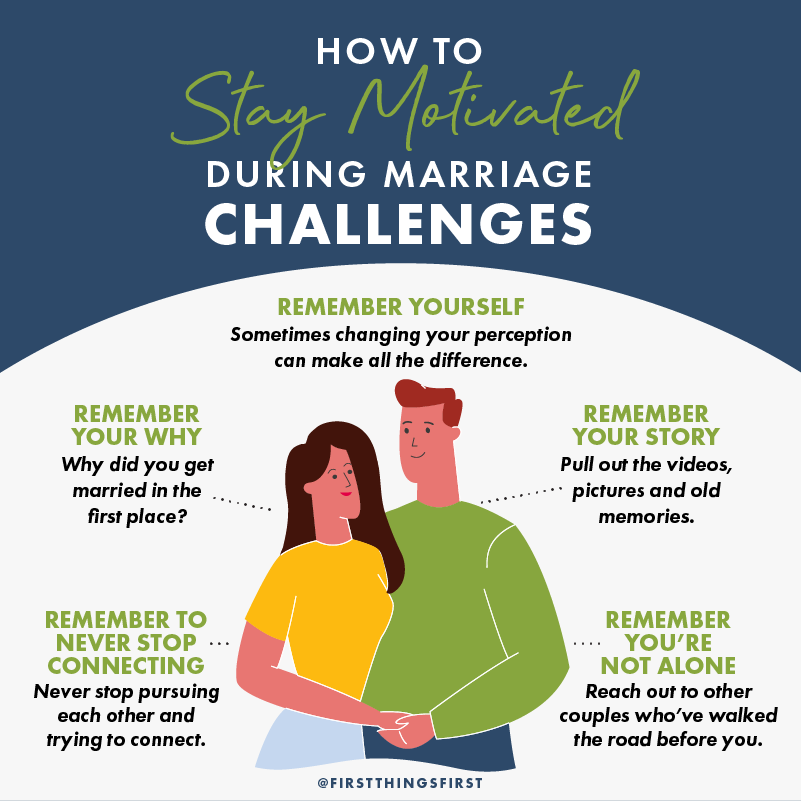
Remember your why.
Why’d you get married in the first place? People marry for several different reasons: love, kids, a passion for another, to have companionship. Your why doesn’t have to match anyone else’s why. The neverending nature of your why can help you outlast the temporary challenges you face in marriage.
Remember your story.
Pictures. Videos. Experiences. Memories mean little without the story attached to them. You look at them to remember the story. It connects you with the positive energy captured during the moment that’s worth remembering. Let that energy motivate you to keep going. Your story helps you remember what you’ve built together.
It isn’t just about reliving your past. It’s about guiding and maintaining your perception of your spouse and your marriage. It is about truly seeing the person you’re with. It’s about being reminded of who you are and even how you’ve evolved over the years.
Remember to never stop connecting.
Keep searching for better ways to communicate, be playful, and spend quality time with one another. Regardless of how challenging marriage gets, to stop communicating is never the answer. Connecting in hard conversations, through disappointments, and in the midst of hurt is better than not communicating at all. Anytime you stop talking, you’ll slowly feel the wedge between the two of you grow bigger.
Remember you’re not alone.
Hearing a couple who had been married for 40 years share some of their darkest moments was motivational for my own marriage. They were proud to have made it 40 years, and I could sense they felt their life was better for it. Since then, I’ve learned many couples, if not most couples, have gone through difficult moments where they felt like giving up was really the best option on the table. So, when you find yourself hurting and questioning if it’s worth it to hang on, reach out to other couples who have walked the road before you and made it to the other side in one piece. Connecting with other healthy couples who are willing to be honest and real can inspire you to stay focused on your marriage when it appears hopeless. Also, a good marriage counselor can help you work through some of the toughest marriage challenges.
Remember yourself.
Sometimes we get so focused on what our spouse is or isn’t doing we lose sight of ourselves. Research shows when a person has a negative perception of work, family, themselves, and just life in general, they are more likely to be unhappy in their relationships. Continue to grow and practice good self-care. It may help you to get a fresh perspective that can help you thrive in the midst of some of the most difficult times.
When you remember these things, you’ll realize no matter how big the problems may seem, your commitment to each other is bigger. The urge to stop trying is real. But, you have everything you need in your memory bank to fight the urge to quit and help your brain to keep moving forward. The darkest part of a cave is right before you see the light. Focus on using the tools you have to get to the light and stop the darkness from making you a permanent resident.
***If you or someone you know is in an abusive relationship, contact the National Hotline for Domestic Abuse. At this link, you can access a private chat with someone who can help you 24/7. If you fear someone is monitoring your computer or device, call the hotline 24/7 at 1−800−799−7233. For a clear understanding of what defines an abusive relationship, click here.***
Married. You and your spouse talk every day and you sleep in the same bed. You share bills and responsibilities. Of course, you have sex. You do all the things married couples do. Yet you so often feel unheard and unknown by your spouse.
You don’t feel like your spouse knows your hurts and pains. They’re unaware of what causes you to be fearful or insecure. When the two of you talk about personal or intimate matters, you don’t feel like your spouse gets you even though you shared exactly what you were thinking and feeling.
You’ve made comments to express your feelings that they didn’t get. Your conversations are not fulfilling. It’s made your sex life one-sided because you don’t feel known or heard so you’re not as into giving yourself to your spouse in that way. And you’re not sure if they notice or even care.
How does this happen?
One possible explanation is your spouse isn’t curious about you anymore. Curiosity pushes someone to want to know all the complexities of their spouse’s thoughts, personality, dreams, and feelings. It drives you to understand how past experiences affect your spouse in the present.
Curiosity can stop for several reasons:
- Your spouse believes they know all the important things there are to know about you.
- The busyness of life has subconsciously shifted the priorities.
- Your spouse has become more focused on themself.
- Complacency in the relationship and in their own personal growth.
As a result, spouses often don’t hear their partner’s cries to be heard. They miss the snarky comments, make assumptions about the marital silence, and overlook opportunities presented to show they hear and know you. You may be evolving or even changing, but your spouse still speaks to you based on how you thought when the two of you first got together.
What can you do about it?
Yes, you have to talk about it. The struggle of letting your partner know you’re feeling unheard and unknown is getting them to hear from you. Ironic, right? This is a conversation that my wife and I had for years before I finally heard her. Did I think I’d heard her before? Of course, I did! I’d listened to what she said and tried to treat her based on the words she said. However, she knew I didn’t hear her because I didn’t become genuinely curious about her. I was still interacting with her as if she hadn’t grown or evolved since we first met. Consequently, I was missing out on getting to really know her and her new ideas, dreams, and desires.
You’ve probably tried many times to get your spouse to really hear and know you. All to no avail.
Here are the keys to being truly heard by your spouse.
- Gentleness. Getting louder, forceful, or playing the blame game is not the way to get heard. Marriage therapist and researcher John Gottman has coined the phrase, “Gentle Start-Up.” You can attack your spouse with insults or approach your spouse with gentleness. It hurts to be married and feel unknown, but to approach your spouse with anger and rage is more likely to cause defensiveness than to birth helpful conversation.
- Be Direct. Don’t Hide Your Emotion. Your spouse does need to see your emotions in a healthy way. Nothing violent, abusive, or manipulative. Hurt, neglect, sadness, and loneliness are all real emotions that can help your partner understand the gravity of the problem.
- Perception. Approaching your spouse from the perspective that they do want to make you happy. They love you and want your marriage to work. Battling the tension between feeling like your spouse is not interested in you and knowing they love you and want you happy can be tough, but it is doable.
- Clarity. What makes you feel heard and known? When do you feel lonely within your marriage? It may take several conversations to communicate all that’s on your heart and even more for your spouse to get it. Repetition from a gentle spirit is helpful.
Don’t Give Up.
If the two of you are both well-intentioned and you both want the marriage to work, then keep pressing forward. Talking to other couples who have experienced similar struggles can be encouraging. Talking to a marriage counselor may be empowering. I’ve heard many spouses say that after so many years, “My spouse finally gets me!” When that happens, you go from the feeling of being unnoticed and unknown to experiencing levels of connectedness and intimacy that’s very difficult to find outside of a committed relationship. A marriage where you both feel heard and known is a relationship that offers the security and comfort which brings peace to the soul.
***If you or someone you know is in an abusive relationship, contact the National Hotline for Domestic Abuse. At this link, you can access a private chat with someone who can help you 24/7. If you fear that someone is monitoring your computer or device, call the hotline 24/7 at: 1−800−799−7233. For a clear understanding of what defines an abusive relationship, click here.***
How to Find Good Relationship Advice
You want to have good relationships. You want a healthy marriage AND you want to be a great parent, a wonderful friend, fiancé, or co-worker.
But relationships are sometimes complex. They aren’t always easy. Issues arise. And if you’re like me, you could just use some help sometimes.
The internet gives us ENDLESS information on relationships. Just Google how to resolve conflict in marriage or how to parent a rebellious teenager. Then watch TONS of articles, blogs, videos, how-tos, and step-by-steps fill your screen.
It’s overwhelming.
And here’s the thing: can they all possibly be right? I mean, with literally thousands of resources out there on any given relationship subject, there’s got to be some conflicting information and something that’s not accurate. (As a matter of fact, there is.)
★ So when you and I are trying to get help in the area of healthy relationships, how do we know what kind of information to trust? How do you wade through the countless sources of information on your screen and determine which advice is legit?
I’ve been on both ends of this spectrum, searching for accurate relationship advice as well as writing relationship content as accurately as possible. And I can tell you there is a lot of good information out there, as well as a lot of bad.
Here are some pointers I’ve found helpful on how to identify reliable relationship advice.
Understand that relationships are something that’s actually researched.

Seriously, there’s a whole science behind it. There are a lot of experts and researchers out there looking at questions like what makes a marriage great, what kids need from their parents, what are the best ways to resolve disagreements, what role does intimacy play in relationships, etc. And, they’re observing and testing answers using psychological research techniques.
This is good to know because it tells us that there is, indeed, reliable information out there to tap into for our relationship questions and struggles. Good sources of information are typically (but not always) written by researchers who have either done the science themselves or by professionals who have used the science to counsel others. That’s usually what I want to look for when it comes to good relationship advice.
On the flip side of the coin… know that just because the word “research” shows up doesn’t always mean it’s great advice.
I’ve read countless articles using the words research says… or studies prove… or a survey of 500 people tells us… If you search for any kind of advice about relationships, you’ll find this, too. And it sounds very convincing.
But for many reasons, it doesn’t always mean you can trust the advice. For one thing, it’s easy for writers to twist the words of a piece of research out of context to fit their own point of view. Not to mention, a lot of research just plain isn’t done well. You don’t have to be any kind of research expert to take what you read or watch with a grain of salt or even sense there could be some missing information.
I’m not saying count these kinds of articles out. Give them a chance. Just approach them with a more critical eye. And here’s something I’ve found: if you come across an article that says some sort of research proves something, approach with caution. Researchers don’t try to prove anything. The goal of the research is to provide evidence of one thing or another and spark people to study the question even more. Claiming proof for something could be a big red flag that the writer could be twisting some facts.
All this goes to say, of course, to consider the source.
With any article or video, take a quick look at the author’s bio. Google them. Do they have a background in relationship research, education, or counseling? Are they associated with a university or an organization specializing in relationships like marriage or parenting? Do they have a product to promote? Does their writing seem to have an agenda? Does it sound like they have a chip on their shoulder (like they’re ready to pick a fight)? Or, are they simply trying to report the best information out there as objectively as possible? These are all important questions to consider.
Do a quick search on “reviews” or “criticism” of the author or the organization they represent. See what other people are saying about them.
I particularly like authors who are transparent about their own relationships and balance it with trustworthy fact-giving. Rather than making bold claims saying what they are doing in their own relationships is the way to go, thank you very much, they tend to admit where they’ve messed up before and humbly say let’s look at evidence of what’s healthy.
Prepare to do a little digging.
I’m confident telling you it’d be a mistake to only consider the first few pieces of relationship advice at the top of your search list. Sometimes these are reliable resources, but not always. The first sites popping up on a search list many times are determined by popularity factors or advertising dollars. This means you could very well be getting relationship advice based on opinions instead of qualified research, and on the fads families of “the rich and the famous” are doing. (This is just my two cents: it’s difficult for me to swallow trying to relate to Hollywood trends in marriage and parenting. I’m not dissing actors or performers; it’s just a totally different world from the norm, and it rarely reflects what we know to be healthy in relationships.)
Dig down below the first few search results and see what else lies beneath. This is often where you’ll find the real gold of reliable relationship advice.
Be cautious with sources that seem to run against the grain of what we already know to be healthy in relationships.
I get a little twitchy when I see titles like The Way We’ve Been Doing Marriage for Decades Is All Wrong! I don’t ignore those sources completely (Who knows?—they might have some good info after all…), but I do tend to read or watch it with a lot more discernment and savvy. Apply what’s been said above to these kinds of articles and determine for yourself if the information given is truly on the level.
Understand how easy it is to find information that supports your current view and quickly rest your case.
These days you can just about find anything that will claim to back up even the wildest of ideas on how to do healthy relationships. (“Survey Proves a Steady Diet of Tacos Will Improve Your Marriage” — I knew it!)
So if you’re simply trying to find something to support the opinion you already have, then guess what? You’re going to find it.
When approaching a piece of relationship advice that may run counter to your viewpoint, I find it helpful to give the information a chance. I’ll often think to myself, “Could there be the possibility that this differing opinion (other than mine) might have some truth to it?” And then, based on all the things I’ve talked about above plus a dose of common sense, I determine if the advice is worth taking.
If you truly want to learn what healthy marriages, parenting, friendships, dating, and work relationships look like, good information is out there for you to get your hands on. But it’s like swimming in the middle of the ocean. There is a virtual sea of information to swim through. Much of the advice is like currents which will guide you safely to the shore of healthy relationships. But there are some riptides of bad information that can drag you further out to sea.
One more thought to leave you with: finding relationship experts online can be extremely helpful.
But let’s not look past the fact that you probably have actual people around you in healthy (but not perfect) relationships who you can lean on. A get-together over coffee where you can ask this person (or couple) questions about how they do things in their relationships can provide some very practical wisdom.
Put the above ideas into practice, lean on the healthy people you know, and I guarantee you’ll learn more about what makes relationships healthy than you ever thought you could have.
***If you or someone you know is in an abusive relationship, contact the National Hotline for Domestic Abuse. At this link, you can access a private chat with someone who can help you 24/7. If you fear that someone is monitoring your computer or device, call the hotline 24/7 at: 1−800−799−7233. For a clear understanding of what defines an abusive relationship, click here.***
8 Ways To Care for Your Spouse’s Mental Health
Full transparency here: I’ve dealt with feelings of depression and anxiety through much of my adulthood. In fact, I brought it right with me into my marriage. Through it all, my wife has been a solid rock of support and encouragement for me and my mental health during those difficult times. And looking back, I’ve been able to catch a glimpse of what she was feeling for me:
I’m worried for his well-being. I know he isn’t himself. His heart is hurting. His mind is swarming. He’s just on edge all… the… time. There’s no life in his voice. He just has a sense of hopelessness, tension, defeat. And I just want him to be happy again so we can enjoy our life together like we once did.
Does any of this sound familiar?
Maybe you’ve had the same thoughts about your spouse. It’s difficult to see the person you love the most experiencing challenges like grief, sadness, anxiety, and stress. It impacts not only your spouse but also your marriage. And you want to help, but maybe you just don’t know how.
Fortunately, there is hope. How can you show care and support for your spouse’s mental health? Here are eight ways:
1. Remind them you are there.
One of the worst feelings someone can have who is experiencing emotional difficulties is feeling like they are alone in their predicament. The continual reminder that you are there for them, you’re there to listen, and you are not there to judge or think less of them because of what they’re going through means the world.
2. Encourage your spouse with The Big 3: Exercise, Diet, and Sleep.
These are the three best things we can do to help ourselves when our mental health is under attack. They are the “hubs” of self-care. Physical activity, especially cardio, and clean eating have been shown to improve emotional health. And I can’t tell you enough just how important sleep is to fight off stress, anxiety, and depression. Most people need 8-9 hours of sleep each night, and each one of those hours is precious to care for yourself. Encourage your spouse to maintain The Big 3 and join them in the mission to work out, eat clean, and sleep well.
3. Do everyday activities together.
When I’ve felt particularly out of sorts, my wonderful wife would invite me to go on an errand with her or to do something seemingly mundane with her around the house. The sheer act of being together and focusing on some activity — picking up the groceries, folding the laundry (lots of bonding happens over folding fitted sheets), getting the car washed (for an added bonus, jamming out to Led Zeppelin as your car shuffles through the automatic wash, an instant feel-good) — can help pull your spouse out of a funk.
4. Coach your spouse to choose their “Something to Look Forward to.”
Long ago, a friend of mine gave me this life-changing, simple piece of advice, and my wife has encouraged me with it: every week, choose that one thing that you’re going to look forward to on the weekend (or whatever the “end of the week” looks like for your spouse). It can be anything enjoyable: a hike, watching the football game, ordering pizza, eating that piece of cake in the fridge, a fishing trip, working in the yard, smoking some ribs, visiting your favorite fast food place. I’ve found that whatever setbacks I experience through the week, sometimes my “Something to Look Forward to” is what helps me to keep taking each step forward. Help your spouse find their “Something to Look Forward to” each week.
5. Experience some fresh air together.
There’s something about being outside in the open air and the warm sunlight that takes the edge off strong emotions. Invite your spouse to share some outdoor time, whether it’s hiking in the woods or sitting on the front porch to watch the sunset. You certainly don’t have to be an “outdoor person” to gain the benefits that clean air and the vitamin D from sunlight provides (which, by the way, has been shown to reduce depression and boost weight loss).
6. Be physically intimate with each other.
Physical touch, whether it’s sexual or non-sexual touch, like holding hugs or hand-holding, has been shown to help improve mental and emotional health, not to mention increase closeness and connection with each other. Healthy physical touch from someone who cares (that is, you) causes those feel-good chemicals to squirt through the brain, defending against feelings of sadness and anxiety. And don’t laugh, but scheduled sex is where it’s at. Hear me out. If your spouse is someone who, say, really enjoys sex, more than likely it’s a stress-reliever for them. When the two of you schedule your lovemaking, you give them something they can count on to simmer down the emotions while you, well, heat things up.
7. Encourage time with friends and family.
It’s easy for someone weighed down with heavy feelings to isolate themselves. Sometimes you just don’t have the energy to reach out to others. When I’ve felt like this, my wife would sometimes say something like, “Why don’t you call up your friend Brian and see if he wants to watch the football game?” Or, “Why not go over to your mom’s house and take her some cookies” Being with others helps a heavy heart. And sometimes a person just needs a shot of encouragement to make that connection. Encourage time with someone they are close to when the mood is down.
8. Go on dates.
This is arguably the most important item on the list. Try to have a weekly date together. It doesn’t have to be elaborate or expensive or even outside the house. As a matter of fact, take some of what’s above and make it a date: the “Something to Look Forward to,” time spent outdoors, ordering a pizza in, a walk around the neighborhood, a Netflix movie, or maybe even scheduled intimacy. The point is to have a meaningful time together. And remember: because your spouse is dealing with heavy emotions, you may have to be the one to prompt these dates.
If you observe that your spouse’s mental health doesn’t change for the better or gets worse, encourage them to visit a professional counselor. Offer to go with them if they are nervous or uncertain. Try to help them understand that talking to a counselor doesn’t mean they are “broken” or something “is wrong with them.” They are simply there to talk through some of the difficult feelings they’re experiencing.
One more thing: the battle to manage strong emotions like anxiety, sadness, or stress is a marathon, not a sprint. Don’t expect instant improvements with a walk in the woods or a night out on the town.
And let’s not ignore the fact that your spouse’s struggles with mental health are hard on you as well; you feel the exhaustion and stress they feel. Be sure you are taking care of yourself. Get plenty of rest and exercise, and make sure you have a healthy support system you can turn to. Practice good self-care.
You are your spouse’s biggest support. And you have the power to instill a sense of hope in them with your love and encouragement. Choose at least one of the strategies above to do this week. Assure your spouse you are there for them no matter what. Go on a date. Share a walk outside. Whatever it is, let them know you are right there beside them. Believe me: it will mean the world to them.
***If you or someone you know is in an abusive relationship, contact the National Hotline for Domestic Abuse. At this link, you can access a private chat with someone who can help you 24/7. If you fear your computer or device is being monitored, call the hotline 24/7 at: 1−800−799−7233. For a clear understanding of what defines an abusive relationship, click here.***
Image from Unsplash.com
5 Signs You Need Some Alone Time
“If we want to live a wholehearted life, we have to become intentional about cultivating rest and play, and we must work to let go of exhaustion as a status symbol and productivity as self-worth.”
Brené Brown
“I’m so exhausted and stressed out!” Is that a cry for help or a badge of honor?
Sadly, we live in a culture that not only normalizes burnout as a way of life but also kinda glorifies it. If you are perpetually busy and exhausted—You. Must. Be. Important!
But at what cost?
Maybe we need to worry more about being healthy people.
Ah, but insights like that usually only come to us when we slow down, find some quiet, and get alone with ourselves. Alone. Solitude. Introspection. “Sorry, ain’t got time for that!” (I think a lot of people intentionally stay busy because they don’t want to have to think about life and look at themselves.) Make time. Being alone is a healthy skill to be cultivated. Being alone is when some cool stuff happens: Inspiration. Reflection. Insight. Wonder. Clarity. Rest and Restoration. Whatever ambition has you so busy chasing, you’re going to need all this stuff along the way. Plus, the people you care about need you to care about you and take care of you.

Here are five signs you need some alone time, stat!
1. Your body is trying to get your attention.
Do you wake up and not feel rested and rejuvenated? Does your body “hit a wall” during the day that sends you to the coffee-maker? Do you catch every cold and flu bug that’s going around? Do you collapse into bed like you just finished a marathon?
Your body might be trying to get your attention. It’s trying to tell you that your batteries are low and need recharging. Some time alone doing something restful and reenergizing might be just the ticket. Make sure it’s something you genuinely find soothing and medicinal—not work-related and stress-inducing.
2. Little things just wreck you.
Things you normally would take in stride or wouldn’t bother you at all now get an exaggerated response from you. It could be a short delay, a slight change of plans, an annoying freeway driver, or someone’s tone of voice, and you’re fuming or crumbling. You know that’s not you.
You’re fragile. You’ve become so busy and stressed you don’t have the margin or emotional resources left to handle life’s little annoyances. Alone-time is anti-fragile time. It strengthens you on the inside. Getting alone in a meaningful, healthy way can give you the focus to regain some perspective, as well as the fortitude to handle bumps along the way.
3. The people in your life are dropping hints…
Learn to put the clues together. That look on your spouse’s face means you snapped at them. That eye-roll from your kid means, “What’s. Up. With. You?”
Your friend or co-worker asking, “Are you okay?” or “How have you been lately?” means “Someone has their Cranky Pants on today!”
Sometimes we are the last person to recognize how we’ve changed and are not acting like ourselves. Learn to pick up on the hints before the hints become arguments, outbursts, or resentment. You don’t want to hurt the people you love even a little bit, but when you’re tired and stressed out, or feeling frustrated and overwhelmed, you tend to take it out on the people closest to you. We all do.
Don’t be afraid to tell the people in your life you need a little alone time. It’s mature and self-aware to say, “Sorry I’ve been a little extra lately. I need to go for a walk and clear my head.” Go to a movie by yourself or send yourself to your room and watch one. Take a book to a coffee shop. Go for that run. Reassure the family that it’s not them, it’s you. (They know.)
4. You’re bored, not interested in anything, and just feel… blah.
You’ve been rushing through your hectic schedule so fast for so long, you don’t remember what to do with some downtime. You’re so burned out, you just don’t feel like doing anything—even the things you normally enjoy. You are listless and lethargic. You aren’t up or down—you’re just there.
Sometimes you need some unproductive, unfocused vegging out alone time. Grab your favorite snack and watch some reruns of your favorite show. Go to a park or out on your deck and just sit. Soak up some sun. To the untrained eye, you look like you’re doing nothing, and that’s exactly what you need. This afternoon’s plan is not to have plans. Feel what it feels like to have no deadlines and no demands on your time. Give yourself permission to clock out for a little while. Feel that? Feels good. (If you feel “blah” for weeks at a time, that’s not good. Get that checked out.)
5. Sometimes, you just know.
Sometimes you do. Listen to that little voice. Quit ignoring it. Stop thinking you don’t really need some alone time or don’t deserve it or it’s a sign of weakness or that you will disappoint someone if you take it. The world won’t stop spinning if you don’t get to everything on your to-do list. Give yourself a break. The reality is, alone time helps bring clarity, creativity, and energy to every part of your life. Your life-goals won’t suffer if you take some time for you; your life-goals will suffer if you don’t.
You got this!
Image from Unsplash.com
How to Move Past an Emotional Affair
Your marriage has been blindsided by an emotional affair. One of you is struggling with thoughts and feelings of betrayal, shock, and hurt. One of you is struggling with thoughts and feelings of confusion, guilt, and sadness. How can your marriage move past this? The good news is, your marriage can not only move past this emotional affair; it can grow stronger because of this difficult circumstance—but both spouses need to be willing to to navigate the aftermath well, both individually and together.
The Spouse Who Had The Emotional Affair
Maybe you weren’t even sure you were having an emotional affair. You might have slid down the slippery slope of innocent friendship to emotional dependency and intimacy with someone who’s not your spouse. Maybe there were issues in your marriage that made it easier for you to begin to disconnect from your spouse and build a relationship with someone else. Maybe this is all about you and the little spark you got from the novelty of someone new and the secrecy of your interaction with them.
Bottom Line: You were doing marital work with someone who wasn’t your marriage partner. You crossed the boundary of faithfulness, exclusivity, deception, and betrayal.
Please read this account of how this individual was able to move past an emotional affair and how their marriage survived and grew stronger. ★ Note the steps that were taken.
[Information in brackets is mine.]
- I admitted it: Shame can only exist in secret. When I was able to voice what was really going on, all the complexities of why I allowed it to go as far as it did and how I had realized the line had been crossed, the shame that surrounded the entire situation dissipated. [This is the first step. Friendships that are innocent don’t have to be kept a secret from your spouse and are nothing to be ashamed of. Come all the way clean with your spouse.]
- I stopped it: I wrote my ex co-worker a lengthy email telling him our friendship had crossed a line and that I felt it was unfair to ourselves and our spouses to continue it. I let him know that I had told my husband and encouraged him to tell his wife and take time refocusing on his marriage too. [Inform this person that your relationship is over. Full stop. Your spouse might want to read your email or listen via conference call. This is one of the first steps in rebuilding trust with your spouse.]
- I set personal boundaries: Hindsight is 20/20, so I was able to look at my mistakes and create a guide for boundaries in future opposite-sex friendships. Such as, I will never write another man something that I wouldn’t want my husband to read. [Your spouse will likely have input for the boundaries to protect your marriage. Be willing to do whatever it takes.]
- I reinvested in my marriage: Obviously no marriage is perfect. There is always work that needs to be done. With my energy and attention refocused on my husband, we grew stronger, together. [This is the key. Your marriage is in the ICU. The “what came first” question doesn’t matter. It’s time to reconnect with your spouse and pour your energy and attention into your marriage.]
I would only add to that excellent advice that you need to apologize to your spouse, ask for their forgiveness and express your commitment to them and your marriage.
If you want to move past the emotional affair, communicate your willingness to do whatever it takes to rebuild trust and your relationship. ☆ You may need professional help to break out of the fantasy world you created and to deal with the addiction-like dynamics of your experience. You may also need professional help to reconnect with your spouse and to pour yourself into your marriage.
Emotional affairs can be just as shocking and damaging to a spouse as a sexual affair. Your spouse might bounce back and forth between hurt, anger, and normalcy. Be open to their needs, whether it is to answer questions or be alone. Understand it will take more than words and it will take time.
You need to be open to and compliant with any accountability related to your phone or other devices as you begin to rebuild trust. You need to accept any other accountability that your spouse deems necessary, including whatever else they need to feel secure, heal, and continue to rebuild trust (even if you think they’re going overboard or being unreasonable). They are probably navigating severe anxiety and hypervigilance. This is not the time to try to negotiate; it’s the time to live out true self-sacrificial love.
This is when you need good friends who are for your marriage and accountability.
The Spouse Who Was Betrayed By The Emotional Affair
You didn’t make your spouse have an emotional affair. Know this, believe this, feel this, but it is also true that affairs do not happen in a vacuum. There is always a context to infidelity and betrayal. The marriage and the affair are usually connected.
Often, the marital context allows for a better understanding of the emotional affair. As marriage therapist Esther Perel points out, “The victim of the affair is not always the victim of the marriage.” As the therapist puts it, “The betrayed spouse, to one degree or another, can be one dimension of the infidelity—just like narcissism, low self-esteem, addiction, or a mid-life crisis can be a key for understanding your spouse’s [emotional] infidelity.”
But make no mistake, your spouse chose to have an emotional affair. Probably in a series of little choices. It all could have been avoided by choosing to ignore a text, to not eat lunch with a coworker, to unfollow someone on social media, to not divulge things to someone that only a spouse should hear. They could have chosen to work on your marriage.
At a minimum, you should know the following:
- Who the emotional affair partner was.
- How long the affair lasted.
- How often they met.
- Where they met.
- How they communicated. (Email, secret texting apps, phone or burner phone, etc.)
If the marriage survives, this information is essential to avoid future affairs and for appropriate accountability and to put boundaries in place. Take time to think about what would be most helpful for you to know. Sometimes when affairs are uncovered, the betrayed spouse says they want to know every single detail of the relationship, only later to discover that all that information wasn’t really helpful.
Understand that men and women generally view emotional affairs differently. In fact, according to a survey by VictoriaMilan.com, an online affair dating site (the U.K.’s AshleyMadison.com) for people who are already married or in relationships, there are some clear distinctions between how men and women view emotional affairs.
Here’s what they discovered:
- 72% of men said sexual affairs were worse than emotional affairs.
- 69% of women said emotional affairs were worse than sexual affairs.
- 76% of women said they would forgive their partner for a strictly sexual affair
- Only 35% of men said they would forgive their partner for a strictly sexual affair.
- 80% of men said they would forgive an emotional affair.
- Only 30% of women indicated they would forgive an emotional affair.
According to this and other research, women are much more unforgiving of emotional connections while men are much more unforgiving of physical ones. Again, understand that, in general, men and women look at emotional affairs very differently.
This is important to acknowledge as you work toward understanding what happened, heal, rebuild trust, grow in security, and strengthen your marriage. Take care of yourself so that you are physically and emotionally healthy and whole.
When you’re ready, you need to offer and communicate true forgiveness. Be open and willing to change as an individual and in how you relate to your spouse. You can’t “dance the same dance” anymore. This is your new, second marriage even though it is with the same spouse. Be intentional about making it strong and healthy!
Expect good and bad days, ups and downs, three steps forward and two steps back. Healing as an individual, healing for your spouse, and healing as a couple is a process. Don’t be discouraged by bad days or setbacks. Have a friend who is for your marriage who can keep you accountable, and you can be honest with and vent to.
Don’t blame and focus on their affair partner. This is understandable but completely counter-productive, can re-traumatize you, fuel intrusive thoughts, and impede healing.
Find resources that work for you. Don’t hesitate to seek out professional counseling for yourself and marriage counseling for you both.
★ Only about 15% of marriages break up directly because of infidelity and end in divorce. According to counselors, couple’s therapists, and marriage coaches, whether the marriage will survive is based on how each spouse responds to the emotional affair.
Some Other Helpful Resources:
- How To Rebuild Trust In Marriage
- Will My Spouse Ever Forgive Me
- How To Save A Marriage That Is Falling Apart
- I Can’t Forgive My Spouse
- Infidelity And Forgiveness
- How Fear Impacts Your Marriage
- Does Your Marriage have Backbone
- How To Find A Good Marriage Counselor
- 5 Ways To Protect Your Marriage
***If you or someone you know is in an abusive relationship, contact the National Hotline for Domestic Abuse. At this link, you can access a private chat with someone who can help you 24/7. If you fear that someone is monitoring your computer or device, call the hotline 24/7 at 1−800−799−7233. For a clear understanding of what defines an abusive relationship, click here.***
